12/21/08

California Cops To Feds: Please Help Us Break The Law!

This from NORML

It’s been twelve years since California voters approved the physician-supervised use, possession, and cultivation of marijuana, and it’s been nearly five years since the state legislature mandated that, “qualified patients … who associate within the state of California in order collectively or cooperatively to cultivate marijuana for medical purposes, shall not … be subject to state criminal sanctions.”

Too bad nobody told the cops.

According to papers recently submitted to Congress by the US Drug Enforcement Administration, representatives from the California Police Chiefs Association believe that they can simply override laws that they philosophically disagree with.

Here’s what Association President Steve Krull had to say about this matter in a 2006 letter to former DEA head Karen Tandy: “[A] concentrated effort [by the DEA in California] sustained over a period of time would send a strong message to local and county government that ‘medical marijuana’ is not allowed [in this state.]”

Except for the fact that it is.

Jacob Sullum over at Reason.com nails the situation here, but my added frustration comes from mainstream media’s utter failure to cover this story. Forget that this topic has any connection to marijuana; the larger and more far reaching issue here is that we now have physical evidence that a rogue group of law enforcement officers are trying to undermine democracy and the rule of law.

Perhaps if this sort of behavior was taking place in a foreign country, the US news media would be investigating the issue seriously. But instead the guilty parties are our own police officers, so the mainstream press simply sweeps the story under the rug.

Nothing to see here, except there is.

11/19/08

Drug Czar Mixes Cannabis, Caffeine, and Cartography With Catastrophic Results

A fortnight ago Scott Morgan wrote this in his blog at Stopthedrugwar.org

The Drug Czar claimed today that San Francisco has more medical marijuana dispensaries than Starbucks coffee shops.

As we've noted previously, state "medical" marijuana laws breed confusion, abuse, and violence in neighborhoods and communities.

Here's our latest analysis of this phenomenon. In downtown San Francisco alone, there are 98 marijuana dispensaries, compared to 71 Starbucks Coffee shops

As is typical considering the source, this is just totally wrong. There are 25 medical marijuana dispensaries in San Francisco, not 98. I contacted Americans for Safe Access today and they had no idea what’s up with this crazy map. Most of the "dispensaries" on the map simply don’t exist. It’s incomprehensible. My best guess is that they’re including doctors' offices, which might write prescriptions, but certainly don’t provide medicine. It might be something even crazier and more dishonest than that.

The thing is, everyone in San Francisco knows where the dispensaries are. They’re only allowed in certain areas. It’s not a secret. This page includes a list of addresses for all of them and, believe me, a lot of people wish it were longer.

So if "marijuana laws breed confusion" as the drug czar claims, it would appear that the confusion remains confined to his office. Regardless of how many Starbucks and medical marijuana dispensaries there are, there is only one place to go if you’re looking for worldclass bullshit drug war propaganda maps.
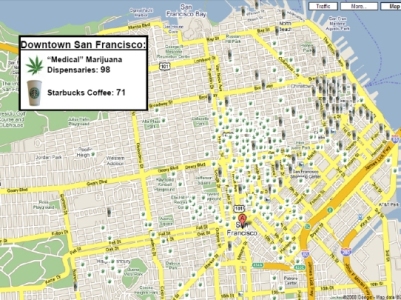

ONDCP's fake marijuana dispensary map

---------------------------------------------------------------------------------

And on it goes............

San Francisco Chronicle Catches Drug Czar in a Crazy Lie

Again from Scott Morgan,

The drug czar's recent claim (above) that there are more medical marijuana dispensaries than Starbucks stores in San Francisco has finally achieved the level of public embarrassment it so thoroughly deserved.

San Francisco's Department of Public Health, which issues permits for medical marijuana dispensaries, is also befuddled by the federal data.

"It was extremely incorrect," said Larry Kessler, a senior health inspector at the department. "I don't know how they got that." [San Francisco Chronicle]

SF Chronicle obtained the alleged dispensary list from ONDCP and found double listings, closed businesses, and even a business in Los Angeles. With their fraud fully exposed, ONDCP has issued a totally bizarre reply saying it's "good news" that their story got press.

It’s straight-up insane. By the time you get to the part about how many Taco Bells there are in San Francisco, you’ll join me in hoping Sarah Palin is the next drug czar so we can at least get MSNBC to give these clowns the daily fact-checking they deserve

MPP'S Marijuana two minute truths # 2

11/12/08

Support For Medical Cannabis Is Broad And The Numbers From Michigan Make It Clear

This from NORML board member and Medical Marijuana patient George Rohrbacher

By a huge margin, 3,008,980 to 1,792,870, Michigan’s voters approved a ballot measure legalizing physician directed medical marijuana, making it America’s thirteenth state to legalize medical marijuana. State medical marijuana laws now cover over 25 percent of the nation’s population. Michigan became the first Midwest state to join this growing green fraternity.

Michigan Voters Pass Medical Marijuana Initiative Into Law, 83-0

A review the Michigan State Auditor’s website and their county-by-county election results proves interesting reading. Medical marijuana won in every single county! All 83 counties in the state of Michigan—urban, suburban, or rural passed the measure, and by a margin of over a million votes. It had won in farming, logging, mining, and manufacturing counties! Everywhere the question was asked in Michigan on November 4, the electorate said yes to medical marijuana. In the state’s five largest urban counties, the margins were enormous, an eye-popping 2:1 vote for marijuana.

Medical marijuana received 130,000 more votes in Michigan than even the Obama victory did.

What a vote like this means is that in every part of Michigan, in every school district and voting precinct, every family and every church, in every community, that the people, one by one, have learned the undeniable truth of the utility of marijuana as a medicine—a ‘Truth’ with no expiration date.

The publics’ first-hand knowledge on the subject (over 100 million Americans have tried pot themselves) is finally overcoming the wall of 71-years of lies and distortions about medical marijuana by our federal and state governments. The American public is slowly re-learning the truth about marijuana as a medicine, one person, one patient, one family, one neighbor and one election at a time.

When Uncle Bob uses cannabis for his MS, and Mom needed pot when she underwent chemotherapy for breast cancer, and the kid next door uses it for his migraine headaches…the government can’t continue to lie to the voters anymore that pot is used only by ‘slackers who’re faking illness just as an excuse to ‘get high’. Sorry Congress and Executive Branch, America has seen too many instances where medical marijuana works, and works well. And, there are also now 17,000 scientific studies on the subject!

The great state of Michigan, as a microcosm of America, showed November 4th we, as a country, have passed our tipping point on medical marijuana. Knowledge is tyranny’s biggest enemy. In the 2008 election, the Michigan voters showed, no matter how thick the government lays on the propaganda, nothing can cover up the truth about marijuana as medicine.

-2008 MICHIGAN ELECTION RESULTS-

* MEDICAL MARIJUANA (YES) total votes  3,008,980 (63%)

* MEDICAL MARIJUANA (NO) total votes   1,792,870  (37%)

* BARACK OBAMA total votes  2,875,308  (57%)

* JOHN MC CAIN total votes  2,050,655  (43%)

-MICHIGAN COUNTIES WON- 

* MEDICAL MARIJUANA (YES) =  83  (100%)

* MEDICAL MARIJUANA (NO) =  0  (0%)

* BARACK OBAMA 48 Counties  (57%)

* JOHN MC CAIN 35 Counties  (43%)

In 1937, when marijuana was outlawed against the American Medical Association’s recommendation, cannabis was a component of at least 28 patent medicines made by many pharmaceutical companies still in business today. This national prohibition not only removed cannabis from use as a medicine, but has also produced the social wreckage of 20 million arrests (with an additional 2,200 arrests daily) and today’s pot prohibition bill to taxpayers approaching $25 billion annually.

With the ever-growing national realization that cannabis is one of “the safest therapeutically active substances known to man…”, the American people are taking back their rights to cannabis as medicine, one state at a time. Starting in California in 1996, thirteen states (eight states via voter initiative – five via state legislation) have now taken back their rights to marijuana as a medicine. After this week’s massive victory in Michigan, it is a clear sign that this culture war over medical marijuana is finally over, and the American people (and science) have won—the citizenry refuse to be denied the use of pot in their medicines chest any longer.

President-elect Obama immediately upon taking office should seat a national commission to update the Shafer Commission and bring forward national legislation to address this vital health care and social issue.

Feature: Big Day for Pot -- Decriminalization Wins in Massachusetts, Medical Marijuana in Michigan, All Local Initiatives Win.

Stopthedrugwar.org

Barack Obama wasn't the only big winner in Tuesday elections; marijuana polled just as well, if not better. A medical marijuana initiative in Michigan -- the first in the Midwest -- and a decriminalization initiative in Massachusetts both won by convincing margins, and scattered local initiatives on various aspects of marijuana policy reform all won, too.

growing_marijuana_indoors 
Medicinal Marijuana plants growing under lights

In both the statewide initiatives, reform forces overcame organized opposition on their way to victory, mostly from the usual suspects in law enforcement and the political establishment. Michigan enjoyed the dubious distinction of a visit from John Walters, the drug czar himself, who popped in to rail against medical marijuana as "an abomination."

"We could be seeing a sea change in more ways than one in this election," said Bruce Mirken, communications director for the Marijuana Policy Project (MPP), which backed both state initiatives. "These are not just wins, but huge wins. In two very blue states, marijuana reform outpolled Barack Obama. At this point, we can look members of Congress in the eye and ask them why exactly they think marijuana reform is controversial."

The results are also an indicator of the decreasing influence of the drug czar's office, said Mirken. "A clear public mandate has emerged, and it's particularly noteworthy coming as it does after eight years of the most intense anti-marijuana campaign from the feds since the days of Reefer Madness," he said. "Despite all the press releases and press conferences, despite all the appearances and campaigning Walters has done to try to convince Americans that marijuana is some sort of scourge, the voters just said no."

In Michigan, the medical marijuana initiative organized by the local Michigan Coalition for Compassionate Care and backed in a big way by MPP won a resounding 63% of the vote. Michigan's new medical marijuana law will go into effect quickly -- ten days after the elections are certified, with the Department of Community Health having 120 additional days to come up with regulations for a registry.

The law will allow patients suffering from HIV/AIDS, cancer, glaucoma and other conditions to obtain a doctors' recommendation to cultivate, grow, and possess marijuana without fear of prosecution under state law. Registered patients may possess up to 2.5 ounces of usable marijuana and have up to 12 plants in a secure indoor facility, or they may designate a caregiver to grow it for them.

"Michigan voters have clearly signaled in no uncertain terms their support for a compassionate medical marijuana law," the committee said in a victory statement Tuesday night. "Our opposition threw the kitchen sink at us, hoping one of their false claims and outright lies would cost enough votes to tank this effort. But Michigan voters saw through the deception, and soon numerous seriously ill patients across the state will no longer need to live in fear for taking their doctor-recommended medicine."

Tuesday's win makes Michigan the 13th medical marijuana state, and, more importantly, the first one in the Midwest. The Michigan victory means planned or ongoing efforts in states like Wisconsin, Ohio, Minnesota, and Illinois just got a little easier.

In Massachusetts, Question 2, the marijuana decriminalization initiative, overcame the opposition of every district attorney in the state to win a resounding 65% of the vote. Now, instead of an arrest and possible six months in jail, people in the Bay State caught with less than an ounce of marijuana will face a simple $100 fine. Equally importantly, small-time possession offenders will not be saddled with a Criminal Record Information Report (CORI), a state arrest report that lingers long after the offense and can impede an offender's ability to obtain jobs, housing, and school loans.

Again backed by MPP, the Bay State's Committee for Sensible Marijuana Policy (CSMP) took the organizing lead in Massachusetts this year. Building on nearly a decade's worth of winning local questions on marijuana policy reform by groups like the Drug Policy Forum of Massachusetts and the state NORML affiliate, MassCann/NORML, the committee was able to go over the top statewide with decrim this year.

"It's great to see the people of Massachusetts were able to see what a sensible, modest proposal Question 2 is," said CSMP head Whitney Taylor. "It's going to end the creation of thousands of new people being involved in the criminal justice system each year and refocus law enforcement resources on violent crime."

While some prosecutors are already whining about having to implement the will of the voters, there appears little chance that legislators will attempt to step in and overturn the vote, as they could do under Massachusetts law. A spokesman for House Speaker Sal DiMasi told local WBZ-TV as much Wednesday afternoon.

"Question 2 now has the force of law and the Speaker sees no reason to consider a repeal or amendment at this time," said David Guarino, DiMasi's deputy chief of staff.

Statewide decrim wasn't the only marijuana-related issue on the ballot for some Massachusetts voters. Continuing the tradition of placing questions on representative district ballots, voters in four districts were asked: "Shall the state representative from this district be instructed to vote in favor of legislation that would allow seriously ill patients, with their doctor's written recommendation, to possess and grow small amounts of marijuana for their personal medical use?"

As with past medical marijuana questions, the question passed overwhelmingly in all four districts.

The question passed with 74% In the 1st Middlesex Representative District (R – Robert S. Hargraves), 71% in the 21st Middlesex Representative District (D – Charles A. Murphy), 73% in the 13th Norfolk Representative District (D – Lida E. Harkins), and 71% in the 6th Plymouth Representative District (R – Daniel K. Webster).

Meanwhile, in other local marijuana-related initiatives:

  • Berkeley, California's, Measure JJ, essentially a zoning initiative that would allow dispensaries operating in the city to expand into more non-residential districts, won with 62% of the vote. The campaign was organized by Citizens for Sensible Medical Cannabis Regulation.
  • In Hawaii County, Hawaii (the Big Island), a lowest law enforcement priority initiative for adult marijuana possession won with 66% of the vote. The campaign organized by Project Peaceful Skies was an outgrowth of the movement to end intrusive marijuana eradication raids.
  • In Fayetteville, Arkansas, another lowest priority initiative passed. Some 62% of voters in the Northwest Arkansas college town agreed with Sensible Fayetteville and its director, Ryan Denham, that police had better things to do than bust pot smokers. Sensible Fayetteville itself is an umbrella organization including the Alliance for Drug Reform Policy in Arkansas, The Omni Center for Peace, Justice & Ecology, the Green Party of Washington County, University of Arkansas NORML and the Alliance for Reform of Drug Policy in Arkansas Inc.

"We think these election results send an extremely important message," Denham told the Northwest Arkansas Times Wednesday. "I'm not surprised since national statistics say that 70% of Americans feel that misdemeanor marijuana offenses should be a low priority. It clogs courts and jails and puts a burden on taxpayer resources."

Election day was a good day for marijuana reform. Let's hope that activists and politicians alike are now prepared to press for more in the near future.

11/6/08

Marijuana Policy Project Alert.....

MPP and our allies across the country passed nine out of 10 marijuana-related ballot initiatives yesterday ... and also defeated a bad initiative. This makes yesterday the most successful day in MPP's 14-year history.

MICHIGAN: MPP's medical marijuana initiative passed by 63% to 37% in Michigan, making it the 13th state to protect medical marijuana patients from arrest and jail. While any new medical marijuana law is a great victory, this one is especially notable, since Michigan is now the first medical marijuana state in the Midwest, and the second largest medical marijuana state in the country (with California being the largest). See http://www.stoparrestingpatients.org/ for details.

MASSACHUSETTS: MPP's landmark initiative to decriminalize marijuana in Massachusetts passed by 65% to 35%. The measure removes the threat of arrest and jail for possessing an ounce or less of marijuana, replacing it with a $100 fine, which can be paid through the mail without lawyers or court appearances, just like a speeding ticket. This is the first time in history that voters have passed a statewide initiative to decriminalize marijuana! See http://www.sensiblemarijuanapolicy.org/ for details.

CALIFORNIA: A measure that would have required the loss of public housing benefits for recent drug convictions lost by a 70% to 30% margin. (The measure would have also increased spending on prisons and law enforcement, as well as increased penalties for gang-related activities and other crimes.)

CALIFORNIA: A measure that would have expanded the number of drug offenders diverted from prison into treatment — as well as improving the marijuana decriminalization law that was originally enacted by the state legislature in 1975 — lost by 60% to 40%. See http://www.prop5yes.com/ for details.

BERKELEY, CALIFORNIA: A measure (which received $5,000 from the MPP grants program) to expand the non-residential zones where medical marijuana dispensaries can locate, issue zoning certificates, and bring Berkeley marijuana possession limits in line with recent court rulings passed by 62% to 38%. See http://www.yesonjj.com/ for details.

FAYETTEVILLE, ARKANSAS: A measure (which received $3,972 from the MPP grants program) to make adult marijuana offenses the lowest priority for local law enforcement passed by 66% to 34%. See http://www.sensiblefayetteville.com/ for details.

HAWAII COUNTY, HAWAII: A measure (which received $19,800 from the MPP grants program) to make adult marijuana offenses the lowest priority for local law enforcement passed by 53% to 39%. See http://www.projectpeacefulsky.org/ for details.

FOUR DISTRICTS IN MASSACHUSETTS: Voters in four out of four state House districts passed four nonbinding public policy questions directing each district's state representative to vote in favor of legislation that would allow seriously ill patients to use medical marijuana if they have the approval of their physicians. See http://www.dpfma.org/ for details.

11/5/08

Ruling Favors Medical Marijuana Users.

Advocates of Montana's medical marijuana law hailed a Montana Supreme Court decision that safeguards the rights of sick probationers and parolees who are prescribed marijuana for pain relief.

In a 6-1 decision Tuesday, the high court said a district court judge in Pondera County exceeded her authority by sentencing a qualifying medical marijuana patient to three years of probation with the stipulation that he could not use medical marijuana.

The patient, Timothy S. Nelson of Conrad, uses medical marijuana to alleviate chronic pain from a car accident. Nelson suffers from a degenerative disc disorder and has had four surgeries on his back. He was thrown from a pickup truck in an accident involving a drunken driver, according to the decision, which was written by Justice Patricia O. Cotter.

Nelson was charged in May 2006 after authorities searched his house and discovered evidence of a marijuana-growing operation. He pleaded no contest to criminal possession or manufacture of dangerous drugs, and received a three-year deferred imposition of sentence. Among the 20 conditions of his probation was an order that he not possess or use marijuana, except in pill form.

Nelson argued successfully on appeal that the sentencing condition ignored the intent of Montana's Medical Marijuana Act, which was passed by voters in 2004.

"The District Court unlawfully denied Nelson the right and privilege to use a lawful medical treatment for relief from a debilitating condition under the Medical Marijuana Act," according to the court's decision. "When a qualifying patient uses medical marijuana in accordance with the MMA, he is receiving lawful medical treatment. In this context, medical marijuana is most properly viewed as a prescription drug."

Tom Daubert, of Patients and Families United, a medical marijuana advocacy group, called the decision "a big victory for Montana patients as well as Montana voters. It reflects a common sense and accurate interpretation of our law, and recognizes the voters' intent."

Daubert said the order limiting Nelson's medical treatment to Marinol, a synthetic version of the active ingredient in marijuana, flies in the face of the voter-passed initiative. Daubert says, and many patients agree, that the synthetic treatment is not as effective because it mimics just one substance in the cannabis plant, when a combination of substances may be what helps relieve the pain.

The law also provides that a qualifying patient may possess up to six marijuana plants and one ounce of marijuana.

"In limiting Nelson to the ingestion of marijuana in pill form, and requiring him to have a physician's prescription to do so, the District Court ignored the clear intent of the voters of Montana that a qualifying patient with a valid registry identification card be lawfully entitled to grow and consume marijuana in legal amounts," according to the decision.

Colin Stephens, a Missoula attorney who represented Nelson on appeal, said the decision reinforces the legal rights of medical marijuana patients.

"I think that this case basically solidifies the rights of qualifying medical marijuana patients," Stephens said. "I don't think right now that probation officers can stop a patient from using medical marijuana as prescribed by a physician. I think it's pretty clear in the case law."

In May, the state Department of Corrections backed down from a proposed rule that would have barred anyone on parole or probation from obtaining medical marijuana without a judge's approval. Proponents of the medical marijuana law argued that the law does not allow any penalty for using medical marijuana, regardless of a person's criminal history.

Daubert said Nelson's is the first substantive case relating to medical marijuana to reach Montana's Supreme Court, and the first case taken on by his advocacy group.

The American Civil Liberties Union of Montana and Patients and Families United worked jointly to defend Nelson.

(GREAT) News From Marijuana Policy Project

image

Huge news — we did it.

Today, voters in Michigan and Massachusetts passed MPP's landmark ballot initiatives to change marijuana policy in their states.

Of the 13 marijuana policy statewide initiative victories in the history of the country, we just scored the second and third most important. (The first was California's medical marijuana law in 1996.)

MPP's Massachusetts initiative was the first time in history that a decriminalization initiative appeared on any statewide ballot, and voters passed it by what appears to be an overwhelming majority. The measure removes all criminal penalties for possessing an ounce or less of marijuana — replacing it with a $100 fine, which can be paid through the mail without lawyers or court appearances, just like a speeding ticket.

And Michigan voters passed MPP's medical marijuana initiative, making Michigan the first Midwestern state to permit medical marijuana use by seriously ill patients (and the 13th in the U.S.). Michigan now becomes the second largest medical marijuana state in the country (second only to California). And as a result of tonight's victory, almost one quarter of the nation now resides in states with medical marijuana laws.

Despite formidable opposition (including lies and dirty tricks from our opponents), common sense won — in large part because of thousands of MPP supporters who donated as generously as they could to both campaign committees.

The majority of these donors don't even live in Michigan or Massachusetts but donated because this is what the movement for changing marijuana laws is all about — a partnership between people across the country, giving whatever they can afford in order to push change forward. The people of Michigan and Massachusetts owe a debt of gratitude to thousands of people in the other 48 states and Washington, D.C., who donated money for victories that they won't personally see in their own states. And this is exactly how it works: In the upcoming two-year cycle, we're going to be choosing a new slate of states, and we'll all pitch in nationwide to pass those too ... which includes passing bills through state legislatures too.


(GREAT) News From Marijuana Policy Project

Huge news — we did it.

Today, voters in Michigan and Massachusetts passed MPP's landmark ballot initiatives to change marijuana policy in their states.

Of the 13 marijuana policy statewide initiative victories in the history of the country, we just scored the second and third most important. (The first was California's medical marijuana law in 1996.)

MPP's Massachusetts initiative was the first time in history that a decriminalization initiative appeared on any statewide ballot, and voters passed it by what appears to be an overwhelming majority. The measure removes all criminal penalties for possessing an ounce or less of marijuana — replacing it with a $100 fine, which can be paid through the mail without lawyers or court appearances, just like a speeding ticket.

And Michigan voters passed MPP's medical marijuana initiative, making Michigan the first Midwestern state to permit medical marijuana use by seriously ill patients (and the 13th in the U.S.). Michigan now becomes the second largest medical marijuana state in the country (second only to California). And as a result of tonight's victory, almost one quarter of the nation now resides in states with medical marijuana laws.

Despite formidable opposition (including lies and dirty tricks from our opponents), common sense won — in large part because of thousands of MPP supporters who donated as generously as they could to both campaign committees.

The majority of these donors don't even live in Michigan or Massachusetts but donated because this is what the movement for changing marijuana laws is all about — a partnership between people across the country, giving whatever they can afford in order to push change forward. The people of Michigan and Massachusetts owe a debt of gratitude to thousands of people in the other 48 states and Washington, D.C., who donated money for victories that they won't personally see in their own states. And this is exactly how it works: In the upcoming two-year cycle, we're going to be choosing a new slate of states, and we'll all pitch in nationwide to pass those too ... which includes passing bills through state legislatures too.


11/4/08

Marijuana: Two-Minute Truths (MPP-TV)

First of a new series of video's from Marijuana Policy Project.

Do you have a question about marijuana? Just ask Nydia!
Submit your questions to socialnetwork@mpp.org with the subject line "Ask Nydia".

-------------------------------------------------------------

JUST HOW BIZARRE IS OUR DRUG CZAR? AKA ARE YOU A UNICORN?.

U.S Law Enforcement: This Weeks Corrupt Cops.

With thanks to Stopthedrugwar.org

One cop offers bribes, one cop takes bribes, two cops take drugs and money. Just another week in the drug war. Let's get to it:

In Beaver County, Pennsylvania, a part-time Beaver County police officer was charged October 22 with offering a fellow officer a bribe to drop drug charges against another man. Officer Kenneth Williams, 55, is charged with bribery and obstruction of the administration of law. A man arrested in February 2007 contacted Williams and offered him $1,000 to act as a middle-man in offering the arresting officer a $5,000 bribe. But when contacted by Williams, the arresting officer reported the incident to his superiors, then wore a wire at his next meeting with Williams to discuss the matter. When confronted with the recordings, Williams said it was "all just a joke." Bet he's not laughing now.

In Fallowfield, Pennsylvania, a former Fallowfield police officer was charged Tuesday with stealing thousands of dollars worth of cocaine and marijuana seized in a 2006 case he investigated. Former Officer Allen Pettit, 46, faces a half-dozen charges, including theft and perjury. Pettit was the last person to have custody of five ounces of cocaine and nearly a pound of pot seized in the bust. Police valued the drugs at $8,500. The dope was discovered to be missing during a hearing in April 2007, when Pettit falsely testified the drugs had been destroyed. He is now in jail trying to raise a $50,000 cash bond.

In Charlotte, North Carolina, a former Lake city police officer was convicted October 22 of taking money to protect drug dealers. Shanita McKnight, 35, was convicted on extortion and drug conspiracy charges. As part owner of a Lake City night club, McKnight tolerated drug and prostitution activities at the club, warned family members and others about pending police actions, and took money from at least one cocaine dealer. Another dealer testified that she let him drive her police car while smoking marijuana. McKnight went straight from court to jail pending sentencing.

In Seymour, Tennessee, a former Sevier County Drug Task Force officer was sentenced Monday to nine months in jail and three years probation after pleading guilty to three counts of theft. Former Deputy Mark Shults, 34, admitted keeping $16,521 that he had seized from drug suspects instead of submitting it as evidence. More than 20 other drug cases had to be dismissed or were not pursued because Shults was involved in them. Prosecutors submitted evidence that Shults was strung out of alcohol and pain pills and got drugs by buying them from dealers of stealing them from the task force. Shults and his family say he is clean now, but he's still going to jail.

10/31/08

Do you want the truth about Marijuana?

10/30/08

The Perfect Argument For Medical Marijuana In Michigan.

This from Scott Morgan at Stopthedrugwar.org

The drug czar likes to complain about the deep pockets of the "pot lobby," and he’s lucky it’s a lie. If we could afford to put this video on the airwaves across America, the federal war against medical marijuana would be over in the blink of an eye. This is the truth about why we do what we do. These are the people who pay the price for our brutal drug laws and their stories are in our hearts each day as we fight for change.
If you live in Michigan, please vote YES on Prop. 1. Tell your friends. Tell your mom. With your support, we can win another important victory for seriously ill patients.


LIVE IN MICHIGAN?, PLEASE VOTE YES ON PROP 1

Cops Lie, Voters Listen. This from NORML.

NORML.ORG

One of NORML’s primary functions is to educate the public. Day in and day out NORML’s staff and affiliates work tirelessly to promote factual and scientific information about cannabis — information that in an ideal world would be provided to the public by drug educators, health providers, and police, were not all three entities directly involved in supporting the continuation pot prohibition.

Why does NORML work so diligently to provide this information to the general population? We do so, in large part, because we know that our politicians opponents — including many members of the before-mentioned groups — have no qualms lying about pot in order to stifle our reform efforts. We also know that the mainstream media rarely takes the time or effort to challenge their disinformation.

Unfortunately, as we are seeing in Massachusetts, lies unduly influence voters — particularly when those doing the lying are those the public trusts.

Since September, a coalition consisting of the state’s 11 district attorneys, along with numerous members of law enforcement, have campaigned vociferously against Question 2 — a proposal to reduce minor marijuana possession to a fine-only offense — falsely claiming that the measure will increase adolescent drug abuse, permit large-scale marijuana trafficking, endanger workplace safety, and sharply increase traffic fatalities. (Reality check: If passed, Question 2 would equalize Massachusetts pot penalties with those of neighboring Maine, which last time I checked, isn’t suffering from any such pot-related catastrophes.)

A recent statewide poll conducted by Suffolk University indicates the extent to which our opponents’ lies are influencing the public. Support for Question 2 has dipped precipitously since the launch of the D.A.s’ campaign (though it still remains above 50 percent), with the greatest loss of support occurring among those age 65 and older. (Support among this voting block fell from 70 percent in August to just 40 percent in October.)

This drop, though troubling, is hardly surprising. Those older Americans who typically lack first-hand experience with cannabis and may be unaware of NORML’s efforts are most susceptible to the lies politicians and police spew about pot.

Conversely, support among younger voters in Massachusetts (those defined by pollsters as 45-years-old and younger) has held above 60 percent despite the cops’ smear campaign. In large part, this is also to be expected. After all, these voters are, statistically, most likely to possess first-hand knowledge of cannabis (or still be current users) and are arguably more familiar with NORML’s educational efforts. As a result, they are more likely to be dismissive of the D.A.s’ cynical rhetoric — as they should be.

Will the D.A.s’ disinformation campaign ultimately be responsible for the defeat of Question 2? We’ll know in eight days, but I remain cautiously optimistic. Previous law enforcement led propaganda campaigns designed to defeat statewide medicinal marijuana initiatives have almost universally failed. That said, it can be argued that older voters — the voting block that has the potential to tip Question 2 one way or the other — more readily identify with the medical use issue than the recreational aspects of pot.

One thing is for certain, our opponents’ smears and scare-tactics have made this battle too close to call — and once again revealed that those who support (or whose livelihoods are based upon) pot prohibition will do or say anything in order to keep our community in cages.

CANNABIS: POLICE SEIZURES SHOW DROP IN DRUG'S STRENGTH

United Kingdom
-------

Official Data Seen by guardian.co.uk Shows Potency of Marijuana Gathered in Police Seizures Has Fallen
The potency of cannabis gathered in police seizures has dropped, new official data reveals, casting doubt on one of the government's key arguments for reclassifying the drug from class C to class B. 
Figures collected by the Forensic Science Service and seen by guardian.co.uk show that the potency of herbal cannabis, which includes the strong "skunk" strain, has dropped from 12.7% to 9.5% since 2004, when it was first moved from class B to the less serious class C. 
This means that samples collected by the police are now weaker than when David Blunkett, the then-home secretary, downgraded the drug in 2004. 
According to the figures the level of THC - the main psychoactive ingredient - in herbal cannabis was 12.7% in 2004, 13.5% in 2005 and 11.3% in 2006, before dropping to 9.5% in 2007, the year covered by the latest figures.  Cannabis resin, a milder form, has decreased in strength from 3.4% to 2.6% between 2004 and 2007. 
The FSS said the figures were not representative and were from too small a sample. 
But David Porteous, a criminology lecturer from Middlesex University, said: "This information suggests that, in the time that it has been a class C drug, usage levels of cannabis have fallen and so has its strength.  These findings make a mockery of the decision to re-reclassify cannabis and of the government's wider claim to base policy-making decisions on scientific research. 
"Furthermore they call into question the validity of other controversial and publicly criticised government claims regarding drug policy, for example the link between cannabis and mental illness or the legitimacy of our current classification system."
Announcing the regrading of the drug in May, home secretary Jacqui Smith told the Commons that the potency of marijuana had "increased nearly threefold since 1995". 
A spokesman for the Home Office said that the home secretary's assertion was based on a report from May this year entitled Home Office Cannabis Potency Study 2008.  This report gave the median potency of sinsemilla ( stronger strains such as skunk ) as 15%, that of other herbal cannabis as 9%, and that of resin as 5%.  No statistics for 1995 were given. 
Another Home Office report, from April this year, also using FSS figures, casts further doubt on Smith's assertion.  It says the strength of sinsemilla, intensively grown cannabis, rose from 5.8% in 1995 to 10.4% in 2007, less than a twofold increase.  The strength of other forms of herbal cannabis was 3.9% in 1995 and 2.6% in 2007, a drop. 
The FSS is a government organisation that supplies forensic science services to ministerial departments, government agencies and police forces.  It released the new figures seen by guardian.co.uk earlier this month. 
A spokeswoman for the FSS said that the figures seen by guardian.co.uk were "unlikely to be an accurate representation of THC in cannabis across the board as not all samples submitted to the FSS are routinely analysed for THC content.  The FSS database also does not distinguish between sinsemilla cannabis and imported herbal cannabis."
She said the FSS had been involved in the May 2008 report used by Smith to make her decision.  "The FSS participated in an in-depth study of THC content for the Home Office in partnership with other forensic agencies, and this is likely to be more representative of actual cannabis strength."
The Home Office spokesman said that skunk now made up "a staggering 81% of seized cannabis".  This was up from 15% in 2002 and just over 50% in 2004-05. 
In May, Smith told parliament the strength of cannabis had increased threefold and there was a "causal link, albeit a weak one, between cannabis use and psychotic illness". 
Explaining why she was going to reclassify the drug as class B from next year, she said: "My decision takes into account issues such as public perception and the needs and consequences for policing priorities.  There is a compelling case for us to act now rather than risk the future health of young people."
Smith's ruling went against the recommendations of the government's scientific experts, the Advisory Council on the Misuse of Drugs, which was asked by Smith to take its third look at cannabis classification in recent years.  The council's advice was that cannabis should remain class C. 
When cannabis was downgraded, the proportion of young people using it fell from 25.3% in 2003-04 to 20.9% now.  Among those aged 16 to 59, the proportion over the same period fell from 10.8% to 8.2%, according to the British Crime Survey.

Will Fayetteville Become The Next City To ‘Deprioritize’ Marijuana?

Marijuana law reformers continue to take the phrase “all politics is local” to heart.

Over the past decade, grassroots activists in numerous towns and municipalities — including Seattle, Washington; Columbia, Missouri; Santa Cruz, Oakland, San Francisco, and Santa Barbara, California; and Denver, Colorado — have successfully campaigned for local ordinances making the enforcement of pot possession laws their city’s lowest law enforcement priority.

This year, a coalition of activists — led by the University of Arkansas chapter of NORML and the Alliance for Drug Reform Policy — have placed a similar proposal on the ballot in Fayetteville, Arkansas (population: 67,000).

If passed, the city will become the second Arkansas municipality in recent years to enact marijuana ‘deprioritization.’ (NORML’s state affiliate championed a similar measure in Eureka Springs in 2006.)

In the days leading up to November 4th, most Americans attention will be directed toward Washington, DC and the Presidential election race. But while we remain focused on national politics let’s not forget about the significant changes taking place locally — one community at a time.

NORML applauds the work of Sensible Fayetteville and the efforts of other local — and often unrecognized activists — not only what they’ve already achieved, but also (and especially) for what they will accomplish in the future.

The Party Is Over Vote YES On Prop 5

10/28/08

Marijuana Horticulture by Jorge Cervantes.

http://www.marijuanagrowing.com/dhtml/images/lookinside/mh_ch_0.pdf

Medical Marijuana users thinking of growing their own medicine can read the  growers bible from Jorge Cervantes in pdf form, simply change the number in the address for each chapter, excellent up to date advice from a renowned expert in the field ( no pun intended ).

Includes information on :-   seeds, vegetative growth, flowering, grow rooms and greenhouses, outdoor growing, lamps, lights and electrical safety, soil and containers, nutrients and watering, hydroponic gardening, harvesting, curing & drying, security.

 image image image

 image 

Some photo's from the book.

10/27/08

Law Enforcement, This Weeks Corrupt Cops

Cops dealing drugs, cops stealing money. More of the same old same old. Let's get to it:

In Memphis, a Bolivar police officer was indicted by a federal grand jury last Friday on drug dealing charges. Officer William Patrick Jordan is accused of buying powerful pain-relieving drugs from undercover informants and selling them to "young girls at the Sonic Drive-In in Bolivar."

In Knoxville, Tennessee, a former drug task force officer was sentenced October 16 to nine months in jail and three years probation for stealing money from drug suspects and from the drug task force to which he was assigned. Former Sevier County deputy sheriff Mark Victor Shults had earlier pleaded guilty to three counts of theft over $1,000. Authorities said Shults became addicted to the drugs he was seizing and stole money to feed his habit.

In Boston, a former Swampscott police officer was sentenced October 14 to six months of home confinement and two years probation for dealing dope. Former officer Thomas Wrenn pleaded guilty to possessing cocaine and Oxycontin in June after being arrested in March during a police sting while trying to buy drugs. He resigned after his arrest.

In Atlanta, a former DEA agent was sentenced September 18 to 21 months in prison for failing to report cash income in 2004. (Sorry, we missed this when it happened.) Gregory Campion, 48, served as an assistant supervisor at a DEA task force office in Atlanta, where he had access to millions of dollars in cash seized from suspected drug dealers. In 2004, Campion deposited more than $200,000 in cash in his bank accounts -- at the same time that seizures conducted during his tenure came up "short" when deposited in banks. He didn't report his income on his tax return, and that's why he is headed for prison.

10/25/08

Parents Are Using Drug Dogs on Their Own Children.

image

Above, 'sniffer dog' with some dope smile_wink

This from Scott Morgan @ Stopthedrugwar.org

I suppose it was just a matter of time:

Ali is a highly trained German shepherd that spent eight years on narcotics patrol with the New Jersey police force, hunting down drug smugglers at airports and drug dealers on inner-city streets. Post-retirement, he's working in the private sector, sniffing teenagers' bedrooms.

Ali and his handler are now working for a new company in New Jersey called Sniff Dogs.

The company, which also conducts business in Ohio, rents drug-sniffing canines to parents for $200 an hour. It was started this year by Debra Stone, who says her five trained dogs can detect heroin, cocaine, crystal meth and ecstasy.

The dogs' noses are so sensitive that they can smell a marijuana seed from up to 15 feet away and marijuana residue on clothing from drugs smoked two nights before.

One of the selling points of this service? Avoiding the kind of confrontation that comes with a drug test. [ABC News]

Yeah, unless Derrick walks in while you’re marching a snarling drug dog around his room. This is ridiculous. Anyway, it makes no sense to do it when your kid isn’t home. The drugs are usually on them, so there’s gonna be a confrontation after all. And subjecting your children to dog sniffs is at least as likely to provoke animosity as a urine test. Who are they kidding?

Parenting is hard and teenage drug abuse is almost impossible to handle exactly the right way. But bringing drug sniffing dogs into your house is just totally crazy, it really is. It’s the sort of approach that only occurs to parents whose over-the-top hysteria about drugs has already eliminated the possibility that their kids would actually tell them anything voluntarily.

10/17/08

Law Enforcement: This Weeks Corrupt Cops.

Thanks as always to Stopthedrugwar.org

More rogue cops in New York City, a Texas sheriff gets busted, some sticky-fingered narcs in Ohio, a would-be pot-growing cop in Florida, and yes, another prison employee busted for getting the inmates high. Let's get to it:

In New York City, two unnamed NYPD officers will likely be indicted shortly for being part of a violent crew that robbed drug dealers, kidnapping and sexually torturing some of their victims. One is an active-duty officer; the other is retired. The pair are accused of wearing their uniforms and acting as "cops" for a crew that stole more than 100 kilos of cocaine from dealers in robberies up and down the East Coast. The crew would kidnap their victims after a police-style car stop or home invasion raid, then take them to remote areas at gunpoint and threaten and sometimes torture them until they gave up their drugs. A dozen members of the crew have already been indicted, but in a September 16 hearing before Brooklyn federal District Judge Nicholas Garaufis, Assistant US Attorney Andrea Goldbarg said she would soon file a superseding indictment, indicating the arrest of the two cops is looming.

In Hidalgo, Texas, the Starr County sheriff was arrested Tuesday for conspiring to smuggle illicit drugs into the country. Sheriff Reymundo Guerra, 52, was charged in a 19-count federal indictment that includes more than a dozen co-conspirators. Federal prosecutors said Guerra possessed with the intent to distribute more than 700 pounds of marijuana and more than two pounds of cocaine. He is also charged with using a phone to facilitate the conspiracy and helping a co-defendant avoid capture by suggesting the use of fraudulent lease documents. Guerra is looking at 10 years to life in prison and a $4 million fine.

In Warren, Ohio, two Trumbull County Sheriff's Office deputies will be fired for allegedly ripping-off an anti-drug charity for their personal gain. Sgts. Pete Pizzullo and Anthony Leshnack were informed that the sheriff has recommended their termination on October 3. The pair founded the Ohio Narcotics Officers Association in 2004 to raise money for charitable organizations with anti-drug messages and, using a professional fundraising company, collected more than $1 million statewide. It is unclear how much of the money the two are supposed to have skimmed off for personal use. The firing is not a done deal; there is an extensive appeals process. The county prosecutor has asked for a special prosecutor to be appointed, but so far, there are no criminal charges against the pair.

In Valdosta, Georgia, a Georgia Department of Corrections prison employee was arrested October 8 for smuggling drugs to inmates. Deborah Watson, 26, a kitchen employee at Valdosta State Prison, went down after investigators asked to search her at work. She refused and quit on the spot, only to be stopped and searched by Valdosta County sheriff's deputies when she left the prison. In her bra, they found three tubes filled with drugs including marijuana, cocaine, and heroin. Authorities valued the drugs at $4,000 on the street and several times that behind bars. That's where Watson is now.

In Orlando, Florida, an Altamonte Springs police officer pleaded guilty in federal court last Friday to setting up a marijuana grow house and having an arsenal of weapons on hand. Clay Adams, 26, pleaded guilty to five federal charges, including conspiring with his wife to grow 2,200 pounds of marijuana. Adams and his wife, Robyn, 32, were arrested July 21 after setting up a grow house in Chuluota. He faces at least 15 years in prison.

10/16/08

L.E.A.P Law Enforcers Against Prohibition.

http://leap.cc/cms/index.php

COPS SAY LEGALIZE DRUGS!
ASK US WHY

After nearly four decades of fueling the U.S. policy of a war on drugs with over a trillion tax dollars and 37 million arrests for nonviolent drug offenses, our confined population has quadrupled making building prisons the fastest growing industry in the United States. More than 2.2 million of our citizens are currently incarcerated and every year we arrest an additional 1.9 million more guaranteeing those prisons will be bursting at their seams. For every year we choose to continue this war it will cost U.S. taxpayers another 69 billion dollars. Despite all the lives we have destroyed and all the money so ill spent, today illicit drugs are cheaper, more potent, and far easier to get than they were 35 years ago at the beginning of the war on drugs. Meanwhile, people continue dying in our streets while drug barons and terrorists continue to grow richer than ever before. We would suggest that this scenario must be the very definition of a failed public policy. This madness must cease!

The stated goals of current U.S.drug policy -- reducing crime, drug addiction, and juvenile drug use -- have not been achieved, even after nearly four decades of a policy of "war on drugs". This policy, fueled by over a trillion of our tax dollars has had little or no effect on the levels of drug addiction among our fellow citizens, but has instead resulted in a tremendous increase in crime and in the numbers of Americans in our prisons and jails. With 4.6% of the world's population, America today has 22.5% of the worlds prisoners. But, after all that time, after all the destroyed lives and after all the wasted resources, prohibited drugs today are cheaper, stronger, and easier to get than they were thirty-five years ago at the beginning of the so-called "war on drugs". With this in mind, we current and former members of law enforcement have created a drug-policy reform movement -- LEAP. We believe that to save lives and lower the rates of disease, crime and addiction. as well as to conserve tax dollars, we must end drug prohibition. LEAP believes that a system of regulation and control of production and distribution will be far more effective and ethical than one of prohibition. We do this in hopes that we in Law Enforcement can regain the public's respect and trust, which have been greatly diminished by our involvement in imposing drug prohibition. Please consider joining us. You don't have to be a cop to join LEAP! Find out more about us by reading some of the articles in our Publications section or by watching and listening to some of our multimedia clips,. You can also read about the men and women who speak for LEAP, and see what we have on the calendar for the near future.

10/15/08

War on Marijuana Failing Despite Drug Czar's Happy Talk, New Report Find.

The White House Office on National Drug Control Policy (ONDCP -- the drug czar's office) has failed on its own terms when it comes to marijuana policy, according to a pair of reports examining government data by a noted marijuana researcher. It has not significantly reduced marijuana consumption despite constantly increasing annual arrest numbers and ongoing propaganda campaigns, while at the same time it twists and distorts figures on people in treatment for "marijuana dependency" in order to falsely claim that marijuana is a dangerous drug, while in reality, less than half of all people treated for marijuana even fit the standard criteria for substance abuse.

4891-Walters_is_Pinocchio
Too much ''happy talk'' from 'Liar' John Walters

The reports, by George Mason University senior fellow Jon Gettman, are available here. They examine official government data from the annual National Household Survey on Drugs and Health and the Treatment Episode Data Set.

Based on the government's own numbers, ONDCP has failed to achieve its stated 2002 goal of reducing marijuana use by 25% by 2007, Gettman found. According to the national survey, last year there were 14.5 million pot smokers, compared with 14.6 million in 2002. From 2002 to 2007 annual use of marijuana declined slightly from 25.9 to 25.1 million. The number of Americans who have used marijuana at some point in their lives actually increased, from 95 million in 2002 to over 100 million in 2007.

Similarly, teenage marijuana use -- the reduction of which is one of ONDCP's stated goals -- remains high. More than one in nine (12%) of 14- and 15-year olds and one in four (23.7%) 16- and 17-year-olds used marijuana in 2007. But disturbingly, there were 472,000 12- and 13-year-olds and 627,000 14- and 15-year-olds who did not use marijuana in 2006 but still used illegal drugs. Nearly half of them used inhalants and illegally obtained pain relief drugs.

More broadly, there were 35.7 million annual illicit drug users in the United States in 2007, 14.4% of the population. Of all illicit drug users, 41% used only marijuana. Another 29% used marijuana and at least one other illicit drug, while 30% used other illicit drugs, but not marijuana.

"The Bush Administration has failed to reduce or control marijuana use in the United States," Gettman concluded. "Marginal changes in marijuana and other drug use have been distorted to support false claims that incremental progress in reducing marijuana and other drug use has been achieved. Marijuana use is fundamentally the same as when the Bush Administration took office and illicit drug use overall has increased. Drug use data do not support Bush Administration claims that its policies have had a significant impact on illicit drug use in the United States."

The stability -- not reduction -- in marijuana use comes despite at least 127 different anti-marijuana TV, radio, and print ads by ONDCP, in addition to at least 34 press releases focused mainly on marijuana and at least 50 reports from ONDCP or other government agencies on marijuana or anti-marijuana campaigns.

For ONDCP head John Walters, slight reductions in teen marijuana use meant that "teens are getting the message about the harms of marijuana and are changing their behavior -- for the better", as he noted in a September 2007 press release. Still, he was forced to admit in the next breath that "youth abuse of prescription drugs remains a troubling concern."

Similarly, in a July press release, Walters called for an "intervention" against adult marijuana use, and tried to define the pot experience as he did so. "Marijuana is the blindspot of drug policy," said Walters. "Baby Boomers have this perception that marijuana is about fun and freedom. It isn't. It's about dependency, disease, and dysfunction. As the data released today reveal, marijuana is a much bigger part of our Nation's addiction problem than most people realize. While teen marijuana use is down sharply [sic], adult use, with all the social, economic, and health consequences that go along with it, will not improve until we start being more honest with ourselves about the seriousness of this drug. Too many of us are in denial, and it is time for an intervention."

"The government's own statistics demolish the White House drug czar's claims of success in his obsessive war on marijuana," said Rob Kampia, executive director of the Marijuana Policy Project (MPP) in Washington, DC. "The most intense war on marijuana since 'Reefer Madness,' including record numbers of arrests every year since 2003, has wasted billions of dollars and produced nothing except pain and ruined lives."

If ONDCP has failed to reduce marijuana use, it has been quite successful in driving up the number of people forced into drug treatment for marijuana use. The problem is that many of the people seeking treatment for "marijuana dependency" aren't dependent and don't need treatment. The percentage of admissions in which marijuana was the primary substance of abuse referred by the criminal justice system increased from 48% in 1992 to 58% in 2006. But less than half (45%) of admissions met the criteria for dependence established by the Diagnostic and Statistical Manual of the American Psychological Association.

"Increases in drug treatment admissions for marijuana, often cited by officials as evidence that marijuana is dangerously addictive, are driven by criminal justice policies rather than medical diagnosis," Gettman noted. "These policies increase public costs for providing drug treatment services and reduce funds for and availability of treatment of more serious drug problems."

Your tax dollars are paying for unnecessary drug treatment for marijuana users. Government programs will pay for drug treatment in 62% of admissions where marijuana is the primary drug of abuse, and 60% of marijuana treatment admissions referred by the criminal justice system.

"In thousands of cases, taxpayers appear to be funding treatment for non-addicts whose only problem is that they got caught with marijuana," said Gettman.

Based on the official data, Gettman also found that ONDCP had demonstrably failed to meet its 2002 two-year goal of a 10% reduction in drug use by teens and by adults or its five-year goal of a 25% reduction in drug use among those two groups. Teen drug use did decline, but by less than ONDCP goals. There was a 7% population reduction in current illegal drug use from 2002 to 2004, and a 16% reduction from 2002 to 2007. But among adults, while the population of current illegal drug users fell 1.5% from 2002 to 2004, it actually increased 4.8% from 2002 to 2007. That increase in adult use of illicit drugs was due to the use of opioid pain relievers, according to the national use survey.

And so goes the war on America's most popular illicit drug. While the drug czar rails against pot, the kids and the adults are turning to pain pills. That's progress?

10/14/08

Police Steal Money From Elderly Medical Marijuana Patients. Another Sickening Story

It is not at all uncommon for the war on drugs to target the very last people among us who ought to be treated as criminals:

For example, the 90-year-old couple, Lester ("Smitty") and Mary Smith--who were raided at their Philo home last week (9.24.08) with law enforcement seizing their life savings and all their plants in the process--are qualified patients with doctors' approvals and did nothing wrong.

Smitty said, "I wasn't worried a bit. I knew it was legal. I planted six plants two years in a row and this year, I planted 17 for me and Mary. That's not too many is it? My wife is very ill, confined to a wheelchair or recliner. She likes the bud tea. She has severe arthritis. It makes it easier for her to get around. She walks easier; she can walk to the bathroom even by herself."

Smitty has health issues too. "I have heart problems, blood clots, stomach cramps, emphysema, bad hips. I've had a heart attack. I sometimes get strong chest pains and can't breathe right. I take nitroglycerine. That brings me back. My doctors want me to take more x-rays here locally but that would be a big expense. Usually, I go to the Veterans Hospital and they pay for it."

Mary Smith was forced to stay in the house by herself during the 5-hour raid while additional warrants for an adjoining parcel were telephoned in and delivered, allowing sheriff's deputies to enter all the residences.

The elderly Smiths were not arrested or charged with a crime, because there was none. Sheriff's deputies were apparently more interested in robbery than arrest. They seized the two things that mattered most to the ill couple--their medicine, all 17 plants, leaving nothing--and their life savings, $52,000 from Mary Smith's inheritance and $29,000 in cashed in CDs.

"As soon as the bail-out hit, I cashed in my CDs and put the money in a safe in my house. I did not sell pot to get it. But turns out my money was not safe. They stormed in here and turned our world upside down. I thought I was legal." [IndyBay]

This is the real war on drugs. It’s not some magic formula that only screws over bad people. The drug war proliferates injustice everywhere it goes.

10/13/08

Go To Beirut It's Safer Than Mexico

Mexico is going so horribly wrong that the State Department is warning Americans who may be thinking about traveling there:

Travel Alert

U.S. DEPARTMENT OF STATE
Bureau of Consular Affairs

This information is current as of Fri Oct 10 2008 19:36:27 GMT-0400 (EDT).

Mexico

April 14, 2008

This Travel Alert updates information for U.S. citizens on security situations in Mexico that may affect their activities while in that country.  This supersedes the Travel Alert for Mexico dated October 24, 2007, and expires on October 15, 2008.

Violence Along The U.S.-Mexico Border
-------------------------------------

Violent criminal activity fueled by a war between criminal organizations struggling for control of the lucrative narcotics trade continues along the U.S.-Mexico border.  Attacks are aimed primarily at members of drug trafficking organizations, Mexican police forces, criminal justice officials, and journalists.  However, foreign visitors and residents, including Americans, have been among the victims of homicides and kidnappings in the border region.  In its effort to combat violence, the government of Mexico has deployed military troops in various parts of the country.  U.S. citizens are urged to cooperate with official checkpoints when traveling on Mexican highways.

What a disaster. If there were anything remotely effective about the war on drugs, don’t you think that trying this policy for several decades would have produced a better outcome than this? I mean, look at it. Seriously, just watch what’s happening. Is this the result you’d get from a drug policy that worked?

Ever since President Calderon took office a year and a half ago and began trying to crack down on drug trafficking, everything has gone to hell. It gets worse everyday because using war to attack the drug supply is a terrible policy that destroys everything except the drug supply. What other conclusion could you possibly reach given what’s taking place right before our eyes?

L.E.A.P

http://leap.cc/cms/index.php


leap_billboard

Senators McCain and Obama:

If elected, will you create a Presidential Commission to study marijuana—its Prohibition, Budgetary, Social, and Health effects, and to make recommendations for marijuana law reform?

By George Rohrbacher, NORML Board Member

Federal law prohibiting marijuana dates from 1937. The Marijuana Tax Stamp Act was debated on the floor of the House of Representatives for just over a minute and against the wishes of organizations such as the American Medical Association. Cannabis, as it was then known, was a component of at least 28 patent medicinesmade by industry leaders such as Merck, Eli Lilly, and Squibb. With the passage of this law, not only did the legal sale and possession of cannabis end, but all American research into medicinal use of marijuana ground to a halt, and even the ages-old knowledge of marijuana as a medicine went into deep remission.

Today there is a whole universe of information on the subject of marijuana that is brand-new since the Shafer Commission last studied marijuana in the 1970’s. The information then available lead Nixon’s own handpicked commission come to a surprising conclusion: they recommended no legal penalties for adults possessing up 100 grams of marijuana. Nixon freaked out, flew into a rage, canceled print runs of the report, and refusing to read the document, he buried the Shafer Commission’s recommendations. Tricky Dick did exactly the opposite and started America’s full-scale War on ‘Weed’, instead. And now forty years later, the War on Pot continues to grind on, getting larger with each passing year. After hundreds of billions of dollars expended, after millions of people arrested, is it not time we studied marijuana again? Because, by every measure available, America’s current approach to marijuana has failed—and, in the words of former-President Jimmy Carter, it is “…doing more harm than good.”

Here are 8 pressing reasons why a Presidential Commission on marijuana is needed now:

1) By October 10, 2008, America will have recorded its 20-millionth marijuana arrest, with people of color and the young arrested in disproportionately large numbers. It is time for a re-assessment of marijuana policy, plain and simple.

2) In addition to the pain and suffering visited by these millions of arrests on “we-the-people”, our government expends about $25 billion annually on its pot prohibition efforts, funds that should be expended elsewhere in the budget.

3) In addition to huge costs on expense side, we lose billions in taxation revenue, as well. Because, despite all government efforts to eradicate it, America’s vast underground marijuana market continues on, just as it has for the last seventy years, creating crime where there need be none, churning out billions and billions of dollars in untaxed and unregulated commerce. A tax and regulate posture as a method of control, verses the ‘no control/out of control’ situation we have today where kids can get marijuana more easily than beer—which alternative should America choose?

4) Marijuana use and purchase has been legal for the last 30 years in The Netherlands. This is the world’s great marijuana legalization experiment—and proof positive that a modern society will not collapse when pot becomes legal. Holland’s tightly regulated cannabis sales have created enormous tax revenues, while at the same time, usage rates for Holland’s teens continues to remain at just half of the usage rates of America’s teens even under our draconian prohibition model.

5) There are more than a dozen states over the last dozen years (covering about 1/5 of the US population) that have passed medical marijuana laws, mostly by voter initiative. ‘We-The-People’ created America’s state-by-state crazy quilt of medical marijuana laws, now what have ‘we’ learned from these experiments?

6) The modern use of cannabis/cannabinoids as medicine, buttressed now by17,000 scientific studies, validates humanity’s medicinal use of cannabis that has been going on for as long as recorded history. In any rational world, a non-toxic, useful drug like cannabis would have been re-scheduled long ago by the federal government from Schedule I, where it now resides with heroin, to Schedule III with most prescription drugs, or lower.

Why have the vested interests blocked cannabis from being rescheduled?

7) On 10/07/03 America’s own Department of Health and Human Services (HHS) received US Patent #6630507 for the use of marijuana’s active ingredients under the title, “Cannabinoids as antioxidants and neuro-protectants.” While HHS filed and supported this application, at the very same time, in other executive-branch Cabinet-level offices, at the ONDCP and the DEA, their legislative charters direct them to fight all use of marijuana as a medicine (the charters contain no standards to correct this prohibitionist posture if marijuana is shown scientifically to be useful as medicine). Either the HHS or the DEA/ONDCP must be wrong.

8.) A Presidential Commission hearing on the subject of marijuana law reform is a necessary exercise in government bureaucracy oversight, and is simply good government.

America, after our 20-millionth marijuana arrest—is that amount of human wreckage not enough? How much longer must our government pursue its failed policy of marijuana prohibition?

Presidential candidates McCain and Obama, show some guts, show some leadership and take the pledge: when you are elected, you will form a Presidential Commission via the National Academy of Sciences, or a like objective review body, to study marijuana.

************************************

NOTE: Now, all you fellow voters out there in Blog-ville: Help me out with this.

Help NORML.

Help America!

The Shafer Commission needs a 21st Century update. Does anybody think we need 10 or 20-million more marijuana arrests before Congress and the White House wakes up and changes our failed marijuana policies?

The Supreme Court has told us repeatedly not to expect a judicial ruling to fix this social disaster; the change, the correction, must come legislatively. Well, 20-million marijuana arrests is enough and a Presidential Commission is what’s needed at the onset of the next president’s tenure to provide the political cover and scientific validation for members of Congress to find the guts to take the votes needed to reform this sorry mess after 70 long, shameful, and pathetic years.

America eventually found the guts to end slavery, a social institution in place for over 200 years, evil and vile in its consequences but fiercely protected by special interests, even state governments; America can find the guts to end marijuana prohibition.

10/11/08

Prop 215 Isn't To Blame For The Recent Violence Involving Medical Marijuana

image

Above- Ridiculous sized marijuana plant!,  pre-flowering stage.

It's harvest time for marijuana growers, which means it's also the time when patch pirates are busy ripping off local gardens.  The result is heightened tension and the possibility of violence, as recent back-to-back incidents in Chico demonstrate. 
They both involved a West Lindo Avenue resident who, awakened from sleep last week by thieves stealing his medical marijuana, rushed naked into the back yard and was shot at.  The next night somebody else tried to steal his pot, and this time he did the shooting, driving them away. 
His neighbors were disturbed to hear gunshots in the middle of the night and to learn of the violence.  Who can blame them? That the plants were legal means nothing to them. 
Before Proposition 215 passed in 1996, backyard gardens were relatively rare.  Besides being illegal, they were hard to conceal from neighbors.  Now, of course, they're legal for up to six plants with a doctor's recommendation.  But a well-tended plant can produce a pound of pot or more, with a street value of anywhere from $4,000 to $7,000-a tempting target for thieves. 
Some people are suggesting Prop 215 needs to be reformed-that it's being abused by profiteers, that six plants is too many, that it's too easy to get a doctor's recommendation, that it's inviting violence into peaceful neighborhoods. 
But the real issue here isn't the voter-approved measure to relieve the suffering of sick people.  Proposition 215 would work fine if marijuana weren't so valuable and thieves weren't tempted to steal it.  And the reason it's valuable is because, for everyone except med-pot users, it's illegal. 
All kinds of growers and dealers are making major money providing millions of pot smokers with their herb.  They can charge high prices because of the legal risk involved.  And as long as there is so much money to be made, law enforcement will never stop the growing or the trading.  Anybody who wants to obtain marijuana can do so. 
Prohibition of marijuana has the same consequences that prohibition of alcohol had in the 1930s-illegal trafficking, gangsterism and violence-and serves no useful purpose.  As drugs go, pot is relatively innocuous compared to, say, methamphetamine.  If it were decriminalized, its value would plunge, innocent medical-marijuana users wouldn't have to worry about thieves, and neighborhoods wouldn't be disrupted by violence.  In addition, police would be freed up to deal with the really dangerous drugs like meth. 
It's not Prop 215 that needs reform; it's the laws prohibiting marijuana use. 

Is There Anything CBD Can’t Do? Then Why Is It Illegal?

This from NORML


While the prohibition of cannabis is absurd, the ban on the plant’s non-psychoactive components is even more mind-boggling — particularly when it’s apparent that these compounds possess amazing therapeutic properties. Case in point: cannabidiol (CBD).

A just published scientific review by Sao Paulo University (Brazil) researcher Antonio Zuardi reports that there’s been an “explosive increase” of interest in CBD over the past five years. It’s apparent why.

“Studies have suggested a wide range of possible therapeutic effects of cannabidiol on several conditions, including Parkinson’s disease,Alzheimer’s disease, cerebral ischemia, diabetes, rheumatoid arthritis, other inflammatory diseases, nausea and cancer,” Zuardi writes. Let’s look at a few of these in detail, shall we?

1. Antiepileptic action
“In 1973, a Brazilian group reported that CBD was active in … blocking convulsions produced in experimental animals.”

2. Sedative action
“In humans with insomnia, high doses of CBD increased sleep duration compared to placebo.”

3. Anxiolytic action
“CBD induce[s] a clear anxiolytic effect and a pattern of cerebral activity compatible with an anxiolytic activity.”

4. Antipsychcotic action
“[C]linical studies suggest that CBD is an effective, safe and well-tolerated alternative treatment for schizophrenic patients.”

5. Antidystonic action
“CBD … had antidystonic effects in humans when administered along with standard medication to five patients with dystonia, in an open study.”

6. Antioxidative action
“[I]t was demonstrated that CBD can reduce hydroperoxide-induced oxidative damage as well as or better than other antioxidants. CBD was more protective against glutamate neurotoxicity than either ascorbate or a-tocopherol, indicating that this drug is a potent antioxidant.”

7. Neuroprotective action
“A marked reduction in the cell survival was observed following exposure of cultured rat pheochromocytoma PC12 cells to beta-A peptide. Treatment of the cells with CBD prior to beta-A exposure significantly elevated the cell survival.”

8. Antiinflammatory action
“CBD, administered i.p. or orally, has blocked the progression of arthritis.”

9. Cardioprotective action
“CBD induces a substantial cardioprotective effect.”

10. Action on diabetes
“CBD treatment of NOD (non-obese diabetic) mice before the development of the disease reduced its incidence from 86% in the non-treated control mice to 30% in CBD-treated mice. … It was also observed that administration of CBD to 11-14 week old female NOD mice, which were either in a latent diabetes stage or had initial symptoms of diabetes, ameliorated the manifestations of the disease.”

11. Antiemetic action
“The expression of this conditioned retching reaction was completely suppressed by CBD and delta9-THC, but not by ondansetron, [an] antagonist that interferes with acute vomiting.”

12. Anticancer action
“A study of the effect of different cannabinoids on eight tumor cell lines, in vitro, has clearly indicated that, of the five natural compounds tested, CBD was the most potent inhibitor of cancer cell growth.”

In sum, the past 45 years of scientific study on CBD has revealed the compound to be non-toxic, non-psychoactive, and to possess a multitude of therapeutic properties. Yet, to this day it remains illegal to possess or use (and nearly impossible to study in US clinical trials) simply because it is associatedwith marijuana.

What possible advancements in medical treatment may have been achieved over the past decades had US government officials chosen to advance — rather than inhibit — clinical research into CBD (which, under federal law, remains a Schedule I drug defined as having “no currently accepted medical use”)? Perhaps it’s time someone asks John Walters or the DEA?

10/10/08

Lies In The War On Marijuana Reform

“Saying that marijuana is harmless is like saying that a dog is a cat.”

“Scientific research does not indicate marijuana is medicine.”

“All major national medical associations have rejected it.”

Sound wrong to you? It is. Blatantly and outrageously so. But these lies, and others like them, are being spread by the Drug Free America Foundation, in a cynical campaign to undermine the enormous progress that marijuana policy reform has made. As the Pro Marijuana groups rack up more and more victories, the opposition gets more and more willing to lie outright.

Watch MPP's new video fact-checking these lies before you decide where you stand, 'Reefer Madness' style nonsense has no place in the debate, it is an insult to YOUR intelligence.


10/5/08

Coming Soon - US Law Enforcement's 20 Millionth Marijuana Arrest

An odometer roll over effect of sickening proportions is about to happen this October: American law enforcement will make its 20-millionth marijuana arrest. Regrettably however, America will not be one step closer to any solution of this “problem” than we were when the federal government first started arresting people for cannabis seventy-one years ago today, with the first federal cannabis prohibition arrest of Samuel Caldwell.

Halfway through this epoch in American history known as cannabis prohibition, Richard M. Nixon’s own handpicked Shafer Commission studied cannabis for nearly two years and concluded: no criminal penalties for adult possession of 100 grams of marijuana.

Nixon was shocked by their findings and tried to bury the Shafer Commission’s report. Nixon instead proceeded with the “don’t try to confuse me with the facts, I’ve got my mind made up” approach to governance, and the full-scale war on cannabis commenced.

image

After four decades, this institutionalized war on ganja and its users grows larger with each passing year. This war on otherwise law-abiding cannabis consumers has created literally millions and millions of unnecessary tribulations, taxpayer costs and casualties. In the period 1965-2007* there were 19,342,363 arrests for cannabis offenses, 89% of them for the possession of a small quantity of cannabis. Just before Election Day 2008, cops will arrest their 20-millionth man (or woman) for cannabis.

And if you’re a regular ol’ cannabis consumer or a medical cannabis patient in need of one’s medicine, that tragic 20 millionth arrest could be you!

At the current pace of arrest, the 20-millionth cannabis arrest will happen by Oct. 10, 2008, within a week of the 71st anniversary of America’s very first federal cannabis arrest of the terminally ill Sam Caldwell in 1937. (See Below)


The First Marijuana P.O.W - Samuel R Caldwell - Oct 2nd 1937

image

After a decade of U.S. government scare propaganda that convinced Americans that crazed Mexicans, blacks and fans of jazz clubs were pushing marijuana "reefers" on school children and honest youths, turning them into raving murderers, politicians decided to act.

The U.S. Congress passed the Marijuana Tax Stamp Act. Growing and selling marijuana were still legal, but only if you bought a $1 government stamp. And that stamp was not for sale.
On the day the Marijuana Tax Stamp Act was enacted -- Oct. 2, 1937 -- the FBI and Denver, Colo., police raided the Lexington Hotel and arrested Samuel R. Caldwell, 58, an unemployed labourer and Moses Baca, 26. On Oct. 5, Caldwell went into the history trivia books as the first marijuana seller convicted under U.S. federal law. His customer, Baca, was found guilty of possession.

Caldwell's wares, two marijuana cigarettes, deeply offended Judge Foster Symes, who said: "I consider marijuana the worst of all narcotics, far worse than the use of morphine or cocaine. Under its influence men become beasts. Marijuana destroys life itself. I have no sympathy with those who sell this weed. The government is going to enforce this new law to the letter."

Caldwell was sentenced to four years of hard labour in Leavenworth Penitentiary, plus a $1,000 fine. Baca received 18 months incarceration. Both men served every day of their sentence. A year after Caldwell was released from prison, he died.

9/29/08

Law Enforcement: This Weeks Corrupt Cop Stories

image

From sea to shining sea, cops, jail guards, and court officers go bad. This week, in addition to the usual rogues' gallery of corrupt cops, we get an abusive one, too. Let's get to it:

In Jackson, Alabama, a Madison County deputy resigned last month after an internal investigation found that he either gave narcotics to an inmate or allowed the inmate to take them himself. Deputy Dustin Newman, 24, resigned on August 18 after investigators determined that "the only fact disputed is whether Newman took the drugs from a property box himself or just provided information which led to the drugs being taken by the trusty."

In Knoxville, Tennessee, a University of Tennessee Police Department officer was arrested September 17 for selling drugs in student housing. Officer Matthew Chambers, 35, faces one count of sale and distribution of Schedule II narcotics for selling one oxycodone tablet to a snitch. In a perhaps not so surprising twist, Chambers' attorney claims the snitch is his client's former girlfriend, who ratted him off in an effort to get charges she is facing reduced.

In Mt. Juliet, Tennessee, a Mt. Juliet police officer faces aggravated assault charges after being caught on video using a chokehold on a man suspected of hiding marijuana in his mouth. Mt. Juliet Police Corporal William Crosby pleaded not guilty September 18. Police car video showed Cosby choking James Lawrence Anders Jr. until he passed out during an April traffic stop. Anders was charged with marijuana possession, but those charges have now been dropped, and Anders has filed a civil lawsuit over the incident.

In St. Helens, Oregon, the Columbia County drug court coordinator was arrested over the weekend for allegedly selling drug investigation information to drug dealers and users. Emily Davis Cayton, 30, was initially charged with drug possession, but prosecutors said her case could go before a grand jury and result in further charges any day now. Investigators said they got a tip through their "informant system," but are unsure what information was leaked or how much Cayton was paid. She was arrested after a weeks-long investigation, they said. Cayton is now on paid administrative leave from her drug court gig.

In Walla Walla, Washington, a state prison guard was arrested Monday after being caught bringing "a substantial amount" of drugs into the prison. Prison guard Camren James Jones, 20, was jailed on suspicion of delivering cocaine, heroin, methadone and marijuana. Authorities described the amount of heroin as about the size of two golf balls.

In McAllen, Texas, a former Border Patrol agent was sentenced September 16 to five years in federal prison for lying about cocaine seizures. Juan Espinoza, 31, pleaded guilty to making false statements or entries in August 2006. Investigators found that Espinoza had seized cocaine from drug traffickers and conspired with others to distribute it. He had been free on bond, but now he's behind bars.

In Mineola, New York, a former NYPD officer was sentenced Monday to five years in prison for stealing handguns from a police evidence room and trading them for painkillers. Former Officer Hubertus Vannes had pleaded guilty in May to criminal possession of a controlled substance and criminal sale of a firearm. He admitted trading three guns to a man in return for painkillers and was caught with 76 pills when arrested. The guy he traded the guns to has also pleaded guilty and will be sentenced October 14.

Oregon Group Wants Legal Marijuana Dispensaries

ASHLAND, Ore. (AP) - A medical marijuana activist group is working on an initiative to create marijuana dispensaries in Oregon similar to those in California.

The group called Voter Power hopes to put a measure on the 2010 ballot that would set up a limited number of nonprofit dispensaries.

Under current Oregon law, medical marijuana cardholders must grow their own marijuana or find someone else to grow it for them.

If the dispensary system is approved, patients will still be able to grow their own marijuana or select a grower.

Marijuana is still illegal under federal law - even for medical use. But the federal government typically just monitors the state program for reports of abuse.

9/28/08

Rachel Hoffman Fallout: One Officer Fired, Others Reprimanded

Rachel Hoffman's Tragic Story on ABC's 20/20

image

At long last, we’re seeing some accountability for the officers who got Rachel Hoffman killed after coercing her into working as an informant in the mindbending botched drug sting disaster of the century:

Police Chief Dennis Jones requested that investigator Ryan Pender's employment be terminated.

Jones also wanted this disciplinary action taken: Deputy Chief  John Proctor, reprimand; Capt. Chris Connell, two-week suspension without pay; Lt. Taltha White, two week  suspension without pay; Sgt. David Odom, two week suspension without pay; Sgt. Rod Looney, two week suspension without pay.

Jones is reassigning White, Odom and Connell within the department.

"We have taken the necessary time to conduct a thorough and honest review and asked others to examine our operations," Jones says in the statement from the city. He said he has contacted Hoffman's family and provided a report.

"While we cannot change the events of May 7, we can make the type of changes within the department to help ensure our future actions are consistent with policy," Jones said.

[City Manager] Thompson also issued a reprimand to Jones to require a stronger level of supervision from top to bottom in the department. [Tampa Bay Online]

Anything resembling police accountability in the war on drugs is so rare that we should really take a moment to just reflect on this. Miraculously, we’ve reached a point where all you have to do to get the cops in trouble is be a pretty white girl with a loving family and hundreds of friends, get sucked into a steaming cauldron of first-rate drug enforcement incompetence, and perish dramatically on 20/20’s tear-jerker TV special of the season.

That’s what it takes, because despite the all-encompassing aversion of police officials towards acknowledging even mild misconduct, it’s still easier than conceding that the entire drug informant system is fundamentally corrupt and perverted to its core. This isn’t about Officer Pender, it isn’t about Tallahassee, and it isn’t going to get any better just because a couple incompetent cops got called out. The Burn Em’ & Bail Drug Informant Circus of Horror is a national tour sponsored by the war on drugs and it won’t go away until every last one of us makes it abundantly clear that we want no part of this. Not with our money, not in our community, and not in our name.

Many thanks to Scott Morgan Stopthedrugwar.org

9/25/08

Vested Interests.............

With the record number of cannabis arrests publicized last week, came the usual round of supporter and media inquiries about ‘who actually supports keeping America’s cannabis prohibition in place?’

Without sounding overly jaded, it will not surprise many that a principle root of the problem here is ‘money’. In fact, our tax money.

Washington DC’s Roll Call newspaper had an article last week (10/15/08, pg 9, under the very aptly entitled ‘Vested Interests‘ section) that highlights one of the major sources for cannabis arrests in the United States, and how it’s possible demise in future might have positive effects for cannabis consumers in the coming years. One can argue that a major source of the steady increase in cannabis arrests circa 1992 corresponds closely with the massive federal funding received by local, county and state law enforcement departments in a block grant funding program administered by the United States Department of Justice called the Byrne Justice Assistance Grant Program, known to policy wonks as ‘Byrne/JAG’. The over $500 million in annual funds funneled to state and local law enforcement agencies have largely help establish multi-jurisdictional, multi-agency ‘anti-drug’ task forces that 1) feast on civil forfeiture laws (which often allow law enforcement, not elected politicians, to divide up seized assets labeled ‘drug money’) and 2) run around claiming that America is ‘winning the war on drugs’ or that ‘legalizing cannabis sends the wrong message to children’.

However, over the years a curiously quite and bipartisan effort has been forged to strip down Byrne/JAG from an $520 million annual appropriation to $170 million. That is a real cut in funding, even by the Beltway’s standard voodoo math! President Bush’s budget office, with support from powerful Republicans in the House and Senate, along with the current Democratic leadership, appear poised to engage in one of the most fundamental changes in criminal justice policy in the last 20 years: A de-escalation–an actual reduction–in federal government spending that helps fuels the war on some drugs. And this from Bush 2.0 and the Democratic leadership (who usually don’t agree on much these days), and despite broad support in Congress for law enforcement getting what they want (218 House members, and 56 Senator have signed a letter insisting that Byrne/JAG receive full funding in the proposed federal budget) seem to be, behind the scenes in government, checking some of the excesses of modern federal drug warring.

We’ll see.

9/24/08

Cop Chokes Marijuana Suspect. Revisiting History (with update)

MOUNT JULIET, Tenn. - A Midstate man told how a police officer nearly choked him to death during a traffic stop.

Mount Juliet Cpl. Bill Cosby

Above, Mt Juliet Cpl. Bill Cosby

The incident was caught on the patrol car video.

The Tennessee Bureau of Investigation is investigating how Mount Juliet Cpl. Bill Cosby interacted with James Anders, Jr.

Cosby stopped the 26-year-old Wilson County man in April 2008.

Cosby suspected Anders hid marijuana in his mouth. The officer used a vascular restraint technique to keep Anders from swallowing.

Mount Juliet Cpl. Bill Cosby clutching James Anders' neck.

Above, Mount Juliet Cpl. Bill Cosby clutching James Anders' neck.

On the video recorded inside Cosby's patrol car, Cosby said he smelled marijuana and handcuffed Anders and his passenger.

The video also showed the officer putting his hands around Anders' neck. He applied pressure and told Anders to stick out his tongue. This happened for nearly two minutes before Anders lost consciousness.

Photographs released by Anders' attorney showed injuries he sustained when he fell to the pavement.

Cosby didn't find any marijuana in Ander's mouth. Anders passed a drug test the next day.

A small bag of pot was found in his car and Anders was arrested for simple possession and resisting arrest.

After the district attorney saw the video, the charges were dropped.

Anders is expected to file a lawsuit in federal court later this month.

Cosby is still on the job. **See Update Below Video**

After viewing the tape, General Sessions Judge Barry Tatum dismissed all Cosby's cases. He called what Cosby did inexcusable and said Cosby is no longer welcome in his court.  In essence, any tickets he writes now are meaningless. The judge will dismiss them.

General Sessions Judge Barry Tatum

Above, Gen Sessions Judge Barry Tatum

Anders' attorney said "theres no excuse for strangling a man helpless and handcuffed".

"Clearly his constitutional rights were violated. He was choked," said Garry Vandever, Anders' attorney.

Vandever said Anders is fine but he still upset over what happened.

Anders is expected to file a lawsuit in federal court later this month.

Andy Garrett was sworn in as the new police chief Monday night.

"I have viewed the tape. I wasn't on board when this happened," he said. "It is an incident that's been addressed internally through training and discipline with the police officer. Any further investigation that's going to be done by an outside agency will be referred to the city attorney," said Garrett, a 25-year Metro Police Department veteran who recently commanded the force's Central Precinct.

He succeeds former Mount Juliet Police Chief Ted Floyd who retired several months ago.

In a letter sent to the new police chief and obtained by NewsChannel 5, Tatum said he's "dismissing all cases Corporal Cosby has pending" in his court.

Tatum also indicated that he's "dismissing any (future) cases he attempts to bring."

Tatum said Cosby has "cast a permanent cloud over law enforcement and the judicial system."

"We trust that an officer has to have the type of demeanor that when someone is treating them badly, spitting on them, trying to hit them, that that officer will have restraint in his actions toward that person," said Wilson County General Sessions Court Judge Bob Hamilton.

**UPDATE :- 9.23.2008  Choke Cop Fired - Justice At Last**

MT. JULIET, Tenn. (AP) - A Tennessee police officer has pleaded not guilty to aggravated assault charges after he was caught on video using a chokehold on a man suspected of hiding marijuana in his mouth.

An attorney for Cpl. William Cosby says he pleaded not guilty Thursday.

A lawyer for the city of Mt. Juliet, about 20 miles east of Nashville, says Cosby has been fired.

Cosby's attorney, Chuck Ward, says the decision to fire Cosby shows the city believes him to be "guilty until proven innocent."

Yes, we can plainly see how innocent the cop is in his own patrol car video

County Prosecutors Refused To File Charges So Petty Cop Comes Back With D.E.A

A medical marijuana user has filed a $1-million lawsuit against Seal Beach police for taking up to 50 of his pot plants and allegedly forcing him to become an informant.
The Orange County Superior Court lawsuit filed last month by Bruce Benedict, 43, of Seal Beach, said he's a marijuana patient and caregiver who is allowed by California law to grow and distribute marijuana.

Benedict alleged he called police because of illegal construction in his apartment building and officers smelled marijuana. County prosecutors refused to file charges so officers returned to Benedict's apartment later with federal Drug Enforcement Administration agents in tow, according to the suit.
The pot was confiscated and Benedict was arrested. California law allows medical marijuana but federal law prohibits it.
Benedict's suit said police officers asked him to move out of the city and become an informant in various drug matters. Benedict complied, alleging police told him he would face federal charges if he didn't work for them.

The city has declined comment.

9/23/08

775,000 Arrested For Simple Possession Of Marijuana

"Yet, despite hundreds of billions of dollars spent and millions of Americans incarcerated, illegal drugs remain cheap, potent and widely available in every community"

Nearly 1.9 million people were arrested on drug charges in the United States last year, some 872,000 for marijuana offenses, according to the FBI's annual Uniform Crime Report, released Monday. While overall drug arrest figures declined marginally (down 84,000), marijuana arrests increased by more than 5% and are once again at an all-time high. Drug arrests exceed those for any other type of offense, including property crime (1.61 million arrests), driving under the influence (1.43 million), misdemeanor assaults (1.31 million), larceny (1.17 million), and violent crime (597,000).

Of those arrested on pot charges, 775,000, or 89%, were charged only with possession, a figure similar to that for drug arrests overall. Another 97,000 pot offenders were charged with "sale/manufacture," a category that includes all cultivation or sales offenses, even those involving small-scale violations. Marijuana arrests last year accounted for 47.5% of all drug arrests. Almost three-quarters of marijuana arrests involved people under the age of 30.

The continuing high levels of drug arrests and the increase in marijuana arrests prompted sharp responses from drug reformers. "For more than 30 years, the US has treated drug use and misuse as a criminal justice matter instead of a public health issue," said Bill Piper, national affairs director for the Drug Policy Alliance. "Yet, despite hundreds of billions of dollars spent and millions of Americans incarcerated, illegal drugs remain cheap, potent and widely available in every community; and the harms associated with them -- addiction, overdose, and the spread of HIV/AIDS and hepatitis -- continue to mount. Meanwhile, the war on drugs has created new problems of its own, including rampant racial disparities in the criminal justice system, broken families, increased poverty, unchecked federal power, and eroded civil liberties. Continuing the failed war on drugs year after year is throwing good money and lives after bad."

Marijuana reform organizations naturally zeroed in on the pot arrest figures. "Most Americans have no idea of the massive effort going into a war on marijuana users that has completely failed to curb marijuana use," said Rob Kampia, executive director of the Marijuana Policy Project in Washington, DC. "Just this summer a new World Health Organization study of 17 countries found that we have the highest rate of marijuana use, despite some of the strictest marijuana laws and hyper-aggressive enforcement. With government at all levels awash in debt, this is an insane waste of resources. How long will we keep throwing tax dollars at failed policies?"

For the rest of this from Stopthedrugwar.org  please go here

9/15/08

Presidential Candidates On Drugs.....

Lest folks think that NORML is unfairly biased toward one political party over another, let me reiterate that NORML and the NORML Foundation are required by law to be non-partisan.

(I state this position, again, in response to recent posts proclaiming, inaccurately, that NORML is either pro-Democrat or pro-Republican. In truth, neither of these positions are true, and in fact, NORML’s endorsement of any party, including Greens or Libertarians, would be illegal.)

By contrast, the NORML PAC can raise funds to contribute to “pot-friendly” political officials at the local, state, or federal level. Since 2001, the NORML PAC has contributed over $37,000 to select politicians. These public officials are not selected because of their political party affiliation; they are selected because they have each made exceptional efforts to liberalize America’s antiquated and punitive marijuana laws.

Unfortunately, none of the four major Presidential or Vice Presidential candidates are prior recipients of NORML PAC funding — nor is it likely any of them will be in the future.

On the Democrat ticket, Presidential candidate Barack Obama has flip-flopped twice on the issue of decriminalizing marijuana (replacing arrests and jail terms with small fines) for adults. Although he has made statements supporting an end to federal interference in state medical marijuana laws, he has also expressed skepticism that cannabis has demonstrable therapeutic value, and has said that he would only favor its use under “strict” controls. As a Congressman, Obama has made little-to-no effort to advance marijuana law reform, and has championed various federal anti-drug provisions to increase drug law enforcement efforts both domestically and overseas.

By contrast, Obama’s running mate, Delaware senior Senator Joe Biden — as noted here, here, here, and here — has a 35-year record regarding the drug war, almost all of it disgraceful. Biden’s most recent verbal support in favor of medical cannabis notwithstanding, the bottom line is that the Senator is a primary architect of the federal policies that have brought us: mandatory minimum sentencing in drug crimes, random workplace drug testing for public employees, the 100-to-1 crack versus powder cocaine sentencing ratio, the creation of the Drug Czar’s office, the RAVE Act, and America’s modern federal anti-paraphernalia laws (the statute that comedian Tommy Chong ultimately spent nine months in prison for violating). Most recently, Biden endorsed a nationwide ban on smoking, and he espoused the use of mycoherbicides such as Fusarium oxysporum — a genetically engineered fungal plant killer — in illicit crop eradication efforts.

Predictably, the Republican candidates are no better. During his 26 years in Congress, Arizona senior Senator John McCain has consistently voted in favor of stricter drug enforcement in America and abroad, endorsed Nancy Reagan’s vapid “Just Say No” mantra, backed mandatory minimum sentences and even the death penalty for certain drug offenders, and has repeated scoffed at the notion of medical marijuana, even going so far as to turn his back on bonafide patients.

McCain’s VP pick, Alaska Governor Sarah Palin, has by far the most limited record on drug policy. Like Obama, Palin is an admitted former pot smoker. However, unlike her running mate, Palin may have some sympathy for medical cannabis patients, having served as the Governor of one of the twelve states that has a legal therapeutic cannabis program and chosen not to speak out against it.

In short, both party’s veteran candidates (McCain and Biden) are positively awful on drug policy, while the younger generation (Obama and Palin) may offer reformers at least some minor glimmer of hope.

Bottom line: regardless of who wins the Presidency, marijuana law reform will still be waged primarily on the state and local level — where our support and our victories — continue to grow.

Lunatic Drug Warriors Still Ignore Powerful Pot Science

This from Rob Kampia

Twenty years ago, on Sept. 6, 1988, the U.S. Drug Enforcement Administration's chief administrative law judge issued a landmark ruling, but don't expect any celebrations or commemorations in Washington, D.C. Our government has ignored this historic decision since the day it was issued, inflicting needless misery on millions.

Indeed, most Americans don't know it ever happened.

In response to a petition asking that marijuana be moved from Schedule I of the federal Controlled Substances Act, which bars medical use, to a lower schedule that would permit physician prescriptions, Judge Francis Young held extensive hearings that began in the summer of 1986. He heard from an impressive array of expert witnesses, resulting in thousands of pages of documentation.

Young laid out his findings in a detailed, 69-page ruling, walking readers through the scientific evidence. He concluded that the law didn't just permit moving marijuana to Schedule II, but required it.

"Marijuana, in its natural form, is one of the safest therapeutically active substances known to man," he wrote. "By any measure of rational analysis marijuana can be safely used within a supervised routine of medical care. ... The evidence in this record clearly shows that marijuana has been accepted as capable of relieving the distress of great numbers of very ill people, and doing so with safety under medical supervision. It would be unreasonable, arbitrary and capricious for DEA to continue to stand between those sufferers and the benefits of this substance in light of the evidence in this record."

Remember, this was no pot-addled "legalizer" writing. It was the chief administrative law judge within the top federal agency responsible for enforcing our drug laws. Unfortunately, the ruling had no legal force. In legal terms, it was a recommendation, not an order that had to be followed.

And the DEA chose not to follow it. Six years after top DEA officials rejected Young's recommendation, the U.S. Court of Appeals for the D.C. circuit ruled that the agency did have the right to ignore its own administrative law judge.

Because the federal government chose to disregard the results of its own investigation, the medical marijuana controversy continues to rage today. Losing patience with the feds, 12 states have acted to permit medical use of marijuana under their state laws. If Michigan passes the medical marijuana initiative on its November ballot, that number will increase to 13, comprising roughly 1 in 4 Americans.

But while those state laws provide considerable protection for medical marijuana patients, states cannot provide an exemption from federal law. Even in the 12 states that have medical marijuana laws, patients and caregivers have been arrested, terrorized and even had their children taken away.

Meanwhile, the medical evidence continues to mount. Another federally commissioned study, this time by the Institute of Medicine, confirmed in 1999 that marijuana has legitimate medical uses.

More recently, newly published clinical trials have found that marijuana effectively relieves certain types of hard-to-treat pain, including the nerve pain that often accompanies multiple sclerosis, HIV/AIDS and other diseases. Other research suggests that by relieving the nausea and vomiting often caused by the harsh drugs used to treat hepatitis C and HIV, medical marijuana can help patients stick to these challenging drug regimens -- and live.

Because our government has ignored science, needless suffering has been inflicted on millions of Americans who have benefited or could benefit from medical marijuana. In 2009, we will have a new president and a new Congress, and they should move quickly to end this sorry record of federal stonewalling.

Rob Kampia is executive director of the Marijuana Policy Project.

Victory for California Patients

image

Fresno County’s Board of Supervisors yesterday voted to become the 41st county to implement the medical marijuana I.D. card system required by a 2003 state law, making it easier for police to verify valid medical marijuana patients.

The board was waiting for the results of San Diego and San Bernardino counties’ second legal challenge to the program, which the 4th District Court of Appeals tossed in a unanimous decision last month. In contrast to the Fresno boards’ sensible acknowledgement of the law and their duty to obey it, San Diego’s and San Bernardino’s boards are stubbornlymaking one last futile appeal to the state Supreme Court.

So, with Fresno acknowledging reality and San Diego and San Bernardino clinging to fantasy, that leaves 15 more counties that – five years later – have yet to act. Seems like a simple call: implement a program required by law and supported by the state attorney general and the California Police Chiefs Association or break the law, make law enforcement’s job more difficult, and expose legal medical marijuana patients to false arrest at taxpayer expense.

Every decision should be this easy

9/11/08

Marijuana Policy Project (MPP) Alert........

There are a lot of rumors about what Sen. Barack Obama, Sen. John McCain, and the other candidates may or may not have said about marijuana — and MPP specializes in that.

In fact, during the presidential primary campaign, MPP helped persuade all of the Democratic candidates and three of the Republican candidates to pledge to end the arrest of patients in states with medical marijuana laws.

If you're interested in knowing what the candidates have said and done, please watch the new video:


9/8/08

Feds Raid Wheelchair-bound Paraplegic For Medical Marijuana............

The federal government is so desperate to undermine New Mexico's new medical marijuana law, they've started harassing handicapped people:

MALAGA, N.M. — Agents with a regional drug task force raided Leonard French’s home in southeastern New Mexico on Tuesday and seized several marijuana plants [ For the record, it was actually just 6 seedlings]

But the wheelchair-bound man said he’s certified by the state Health Department to possess and smoke marijuana for medical reasons. The 44-year-old lost the use of his legs about 20 years ago as the result of a motorcycle crash and now suffers from chronic pain and muscle spasms. [Santa Fe New Mexican]

Normally, the DEA would avoid this kind of bad publicity. But since New Mexico's medical marijuana program just started, they're trying to intimidate patients and confuse legislators in other prospective medical marijuana states:

A press release jointly issued by the Pecos Valley Drug Task Force illustrates the political nature of the raid, reading in part, "Citizens of New Mexico need to be aware that they can still be prosecuted on the federal level even though New Mexico has a law permitting marijuana for medicinal use." [DPA]

Drug warriors keep arguing that medical marijuana laws create conflict between state and federal laws, but all they have to do is stop threatening patients and there'd be no problem. They're creating confusion and then citing that confusion as an argument against state laws that protect patients. Meanwhile, sick people like Leonard French are caught in the crossfire, and countless other patients are afraid to try medicine that could help them.

Revealingly, Mr. French has not yet been charged with a crime. You see, DEA is tough enough to arrest wheelchair-bound medical marijuana patients, and even boast about its authority to continue doing so. All of that serves their interest in scaring people and creating doubt as more and more states pass laws to protect their citizens from precisely this sort of foul treatment. But they won't actually try to put him in jail because that would be just hideous.

So the real message here, for those reading between the lines, is that the feds aren't always going to enforce federal law. And that tells you everything you need to know about the debate over medical marijuana. This is all a big stupid publicity stunt, and while there are casualties to be sure (getting arrested and losing your medicine does suck), the whole "conflict with federal law" argument is largely a hoax.

Regardless, we cannot tolerate any federal efforts to scare people out of treating their illnesses with doctor recommended medicine that is legal in their state. That is obscene, and it's no surprise presidential candidates are lining up in opposition to it.

9/6/08

Law Enforcement: This Week's Corrupt Cops Stories. 8.29.2008 and 9.05.2008

Thanks as always to Stopthedrugwar.org

A key Coast Guard anti-drug fighter gets caught doing cocaine, plus the usual array of miscreants in blue. We don't usually mention cases that only involve drug use, but when it's a top Coast Guard commander in charge of fighting drugs, we think we should make an exception to the general rule. Let's get to it:

9.05.2008

In San Francisco, a senior Coast Guard officer who supervised anti-drug trafficking efforts in the Western Pacific was arrested August 20 on cocaine charges. Capt. Michael Sullivan, a 26-year veteran, was charged under military law with wrongful use of cocaine and obstruction of justice, a step that sets up an evidentiary hearing and could prompt a court-martial. Officials gave no further details, but said he had been removed from supervisory duties. Sullivan, who was the Pacific area's chief of response since May 2007, supervised the operation of 20 major Coast Guard cutters and directed law enforcement units that protect ports and fisheries and fight drug trafficking and illegal immigration, according to his official biography.

image

Coast Guard in action....

In Benton, Louisiana, an already convicted ex-cop pleaded guilty Monday to seven additional charges. Former Shreveport police officer Roderick Moore, 53, was sentenced to 15 years in prison after pleading guilty to trading drugs for sex with a stripper in Caddo Parish in June. Now he has pleaded guilty to an additional seven counts of possessing drugs with the intent to distribute. The pleas in the drug cases come two days after he pleaded guilty to driving while intoxicated. Although Moore theoretically faces up to 145 years in prison, his sentencing judge said the sentences would run concurrently. The maximum he faces for any one count is 30 years.

In Jackson, Mississippi, a Jackson code enforcement officer was arrested Sunday after being found with six packages of marijuana and $19,000 cash during a traffic stop. Code officer Britanny Arnold was a passenger in a vehicle driven by another man, who was carrying $670,000 in cash. Both Arnold and the driver are now charged with possession of marijuana with intent to distribute. Both have bailed out of jail.

In Rutland, Vermont, a former Vermont state prison guard was sentenced August 20 to seven months in jail on drug charges. Former guard Sheri Ann Fitzgerald, 44, had pleaded guilty in March to felony possession and sale charges involving cocaine as well as a misdemeanor charge of possessing a narcotic. Fitzgerald had been a prison guard since 1989, but was fired after being arrested. She has until September 4 to get her affairs in order and report to jail.

In Saginaw, Michigan, a jail guard at the Saginaw Correctional Facility was formally charged August 20 with supplying drugs to prisoners. John Singer, 45, now faces one count of delivery and manufacture of marijuana and one count of operating a drug house. He went down after a two-month investigation by the Bay Area Narcotics Team, one of whose members posed as a drug dealer willing to supply him for sales on the inside. He was arrested as he met with the officer in what he thought would be a drug transaction.

In Houston, a deputy constable was arrested August 18 for accosting drug dealers and stealing their money. Precinct 4 Deputy Constable Terrence Richardson is charged with engaging in organized crime and robbery. Word of Richardson's exploits percolated up from underground to the ears of the Houston Police Department, which set up a sting operation that snared him as he tried yet another rip-off. At last word, he was still in jail on a $200,000 bond. He is also now a former deputy constable, having been fired the night he was arrested.

--------------------------------------------------------------------------------

8.29.2008

In Elwood, Indiana, an Elwood police officer was arrested August 29 for stealing prescription pain pills from the department's evidence room. Officer Shaun "Andy" Murray, 28, is charged with official misconduct, theft and possession of a controlled substance after he admitted stealing 10 hydrocodone tablets from the evidence room. Police said he admitted taking pain pills on numerous occasions over the past year and that he had admitted he had a drug problem. Murray went on leave and entered a treatment program August 23.

In Alamance County, North Carolina, an Alamance County jail guard was arrested August 28 on charges she gave drugs to a county jail inmate. Detention officer Jo Ann Hensley, 58, is accused of providing marijuana to an 18-year-old inmate sometime between August 11 and 13. She is charged with drug distribution and possession of a controlled substance on a jail premise. She was fired the same day.

Law Enforcement: This Week's Corrupt Cops Stories. 8.29.2008 and 9.05.2008

Thanks as always to Stopthedrugwar.org

A key Coast Guard anti-drug fighter gets caught doing cocaine, plus the usual array of miscreants in blue. We don't usually mention cases that only involve drug use, but when it's a top Coast Guard commander in charge of fighting drugs, we think we should make an exception to the general rule. Let's get to it:

9.05.2008

In San Francisco, a senior Coast Guard officer who supervised anti-drug trafficking efforts in the Western Pacific was arrested August 20 on cocaine charges. Capt. Michael Sullivan, a 26-year veteran, was charged under military law with wrongful use of cocaine and obstruction of justice, a step that sets up an evidentiary hearing and could prompt a court-martial. Officials gave no further details, but said he had been removed from supervisory duties. Sullivan, who was the Pacific area's chief of response since May 2007, supervised the operation of 20 major Coast Guard cutters and directed law enforcement units that protect ports and fisheries and fight drug trafficking and illegal immigration, according to his official biography.

In Benton, Louisiana, an already convicted ex-cop pleaded guilty Monday to seven additional charges. Former Shreveport police officer Roderick Moore, 53, was sentenced to 15 years in prison after pleading guilty to trading drugs for sex with a stripper in Caddo Parish in June. Now he has pleaded guilty to an additional seven counts of possessing drugs with the intent to distribute. The pleas in the drug cases come two days after he pleaded guilty to driving while intoxicated. Although Moore theoretically faces up to 145 years in prison, his sentencing judge said the sentences would run concurrently. The maximum he faces for any one count is 30 years.

In Jackson, Mississippi, a Jackson code enforcement officer was arrested Sunday after being found with six packages of marijuana and $19,000 cash during a traffic stop. Code officer Britanny Arnold was a passenger in a vehicle driven by another man, who was carrying $670,000 in cash. Both Arnold and the driver are now charged with possession of marijuana with intent to distribute. Both have bailed out of jail.

In Rutland, Vermont, a former Vermont state prison guard was sentenced August 20 to seven months in jail on drug charges. Former guard Sheri Ann Fitzgerald, 44, had pleaded guilty in March to felony possession and sale charges involving cocaine as well as a misdemeanor charge of possessing a narcotic. Fitzgerald had been a prison guard since 1989, but was fired after being arrested. She has until September 4 to get her affairs in order and report to jail.

In Saginaw, Michigan, a jail guard at the Saginaw Correctional Facility was formally charged August 20 with supplying drugs to prisoners. John Singer, 45, now faces one count of delivery and manufacture of marijuana and one count of operating a drug house. He went down after a two-month investigation by the Bay Area Narcotics Team, one of whose members posed as a drug dealer willing to supply him for sales on the inside. He was arrested as he met with the officer in what he thought would be a drug transaction.

In Houston, a deputy constable was arrested August 18 for accosting drug dealers and stealing their money. Precinct 4 Deputy Constable Terrence Richardson is charged with engaging in organized crime and robbery. Word of Richardson's exploits percolated up from underground to the ears of the Houston Police Department, which set up a sting operation that snared him as he tried yet another rip-off. At last word, he was still in jail on a $200,000 bond. He is also now a former deputy constable, having been fired the night he was arrested.

--------------------------------------------------------------------------------

8.29.2008

In Elwood, Indiana, an Elwood police officer was arrested August 29 for stealing prescription pain pills from the department's evidence room. Officer Shaun "Andy" Murray, 28, is charged with official misconduct, theft and possession of a controlled substance after he admitted stealing 10 hydrocodone tablets from the evidence room. Police said he admitted taking pain pills on numerous occasions over the past year and that he had admitted he had a drug problem. Murray went on leave and entered a treatment program August 23.

In Alamance County, North Carolina, an Alamance County jail guard was arrested August 28 on charges she gave drugs to a county jail inmate. Detention officer Jo Ann Hensley, 58, is accused of providing marijuana to an 18-year-old inmate sometime between August 11 and 13. She is charged with drug distribution and possession of a controlled substance on a jail premise. She was fired the same day.

20 Years Of Federal Stonewalling - A Marijuana Policy Project Alert.....

Twenty years ago this week, the Drug Enforcement Administration's chief administrative law judge issued a landmark ruling on marijuana — but our government has ignored this historic decision since the day it was issued.

"Marijuana, in its natural form, is one of the safest therapeutically active substances known to man. By any measure of rational analysis marijuana can be safely used within a supervised routine of medical care ... The evidence in this record clearly shows that marijuana has been accepted as capable of relieving the distress of great numbers of very ill people, and doing so with safety under medical supervision. It would be unreasonable, arbitrary and capricious for DEA to continue to stand between those sufferers and the benefits of this substance in light of the evidence in this record."
— DEA Administrative Law Judge Francis L. Young, September 6, 1988

Judge Young had just finished holding extensive hearings, in response to a petition asking for marijuana to be moved from Schedule I of the federal Controlled Substances Act, which bars medical use, to a lower schedule that would permit physician prescriptions. He heard from an array of expert witnesses, generating thousands of pages of documentation.

Young — the chief administrative law judge in the top federal agency responsible for enforcing our drug laws — laid out his findings in a detailed, 69-page ruling, walking readers through the scientific evidence in detail. He concluded that the law didn't just permit moving marijuana to Schedule II, but required it.

The response? Six years after top DEA officials rejected Judge Young's recommendation, the U.S. Court of Appeals for the D.C. Circuit ruled that the agency did had the right to ignore its own administrative law judge.

And as a result, seriously ill medical marijuana patients continue to be arrested, terrorized, and even have their children taken away — cancer patients living in fear of arrest for using marijuana to quell their nausea and help them keep food down ... AIDS patients using medical marijuana to ease the pain and nausea that too often are side effects of the drugs that keep them alive, terrified of losing their homes if caught ... tens of thousands of people turned into criminals simply for following their own doctors' advice.

Will you help? MPP is systematically working to end this war — state by state, vote by vote. We are making progress every day, but we need your help.

Among other work, your donation will help us pass a medical marijuana initiative in Michigan this November 4, making Michigan the 13th medical marijuana state and the first in the Midwest … adding one more state to the growing number demanding a marijuana policy that works for Americans, not against them.

Won't you invest in change

Thank you,
Kampia signature (e-mail sized)

Rob Kampia
Executive Director
Marijuana Policy Project
Washington, D.C.

P.S. As I've mentioned in previous alerts, a major philanthropist has committed to match the first $3.0 million that MPP can raise from the rest of the planet in 2008. This means that your donation today will be doubled.

Raised in '08
$1,567,354 ( up to end August)
Goal in '08
$3,000,000

Eight Arrested After Discovery Of Elaborate Cross-Border Tunnel.

The reinforced cross-border tunnel, with power.

Eight suspects were in custody Tuesday in the Baja California capital of Mexicali, after state agents caught them digging a clandestine cross-border tunnel with its own elevator, lighting and ventilation systems.

The entrance to the 434-foot passageway was discovered Monday afternoon about a half-mile east of the Calexico border crossing in the upper-middle-class neighborhood of Colonia Nueva. The tunnel leads from a white, wood-frame house about a block from the U.S. border fence, and comes to within about 130 feet of U.S. territory, according to Agustin Perez, a spokesman for the Baja California Secretariat of Public Safety.

Members of the Baja California State Preventive Police raided the residence after an armed man was spotted outside, Perez said. “There was certainly a connection to organized crime,” he said. “The purpose was to smuggle either drugs, people, weapons or all three”

Agents stand around the elevator shaft in cross-border tunnel.

Authorities said they did not know Tuesday which criminal organization was behind the tunnel's construction. At least 75 clandestine tunnels have been discovered along the U.S.-Mexico border since the 1990s, according to U.S. Immigration and Customs Enforcement.

The passageway is nearly 15 feet beneath the surface, Perez said, and measures 5 feet by 5 feet. The elevator was operated by hydraulic pulley, and large enough for three people, Perez said. Workers were installing rails along the tunnel floor, he said.

The eight suspects range in age from 27 to 52 and have been turned over to the Mexican Federal Attorney General's Office, Perez said. “They said the person who paid them was hooded, and they never knew who their employer was,” Perez said. The suspects told agents the tunnel was designed to reach a residence in Calexico.

Lauren Mack, a spokeswoman for U.S. Immigration and Customs Enforcement, said that U.S. authorities are cooperating with their Mexican counterparts. “We found no criminal records on those individuals in the United States,” she said. “They were not under investigation.”

---------------------------------------------------------------------------------

9/2/08

Massachusetts: Three Out Of Four Voters Favor Marijuana Decrim Measure

Boston, MA: Nearly three out of four Massachusetts voters support a statewide ballot initiative that seeks to decriminalize the possession and use of small amounts of cannabis by persons age 18 or older, according to a Channel 7 News/Suffolk University poll of 400 registered voters.

Seventy-one percent of respondents said that they would vote "yes" on the November ballot measure, which would replace criminal penalties for the possession of up to one ounce of marijuana with a civil fine of no more than $100. Only 22 percent of respondents opposed the proposal.

Among respondents over 65 years of age, 70 percent said they backed decriminalization.

The strong poll numbers indicate that the measure "is all but certain" to pass in November, the poll's authors declared in a press release.

If voters approve the measure this fall, Massachusetts would be the first state to enact the decriminalization of marijuana since Nevada's legislature did so in 2001 and the first to do so by voter initiative.

Currently, twelve states have enacted versions of marijuana decriminalization -replacing criminal sanctions with fine-only penalties for minor pot violators.

Michigan voters will also decide on a separate statewide initiative this November that seeks to legalize the medical use of cannabis for qualified patients. If enacted, Michigan will become the thirteenth state since 1996 to authorize the legal use of medical cannabis, and the ninth state to do so by voter initiative.

For more information, please contact NORML Executive Director Allen St. Pierre at (202) 483-5500, or visit the Committee for Sensible Marijuana Policy.

9/1/08

Huge Marijuana Bust, Largest In B.C History

image

Police have made the largest pot bust in the history of British Columbia, finding enough illegal crops to provide everyone in the province with at least one marijuana cigarette.
The bust was made on August 20 on a rural property near the Interior town of 100 Mile House, roughly six hours northeast of Vancouver.
Nearly 15,000 marijuana plants were found in the 23 greenhouses on a property in Bridge Lake, B.C.
Police obtained a search warrant after receiving a tip from the public. The greenhouses were hidden in the hills of the property, many obscured by trees.
RCMP spokesman Const. Craig Douglass says a single crop from the operation uncovered in Bridge Lake last week could produce as many as five million joints.
Six men were arrested on the property and each face possession and trafficking charges. No names are being released at this time.
Police have not said if the men have any previous convictions or were known to them.

8/29/08

Police Cannot Identify Good Marijuana.....

image

Typical police exaggeration,    CHARLESTON, S.C. (AP) - North Charleston police have scored a major pot bust, seizing 500 pounds of marijuana with a street value of more than $2 million.

The cops told reporters there was so much weed they could not let reporters near as the smell would overpower them, when has weed ever been effective simply by standing near it!

Photos reveal the pot to be ugly, brown and stemmy. It was shipped from Arizona, indicating that it is exactly the sort of ubiquitous Mexican commercial garbage that its appearance suggests. I doubt it’s worth even half of the $2 million pricetag proposed by police.

Again and again, we find law-enforcement recklessly exaggerating marijuana prices to the point of absurdity. In fairness, prices shift dramatically depending on quality, but it is precisely because police often lack the subtle ability to judge marijuana quality that they so often issue such laughable claims. This is a really dumb move and just encourages people to grow and sell marijuana

8/28/08

This Weeks Corrupt Law Enforcement Offices

Thanks as always to Stopthedrugwar.org

Cops "misplacing" money, cops providing help to a pot crew, a court security officer peddling pain pills, and a jail guard getting caught bringing in the goodies. Just another week in the drug war. Let's get to it:

In Bartow, Florida, a Lake Wales police officer was arrested August 13 for providing police information to a friend of his who headed up a marijuana distribution ring. Officer Keenan Olson, 50, faces one count of conspiracy to engage in a pattern of racketeering action, five counts of unlawful use of two-way communications device, and four counts of unlawful use of computer access after he was tied to an investigation that ultimately netted 18 arrests. Olson was overheard on wiretapped phone conversations revealing that a certain car belonged to an undercover officer, confirming that an arrest warrant had not been issued for a ring member, and counseling his friend on how to move forward with his marijuana ring by avoiding police-controlled phone calls and drug buys. Olson resigned the day he was arrested.

In Newport News, Virginia, a Curry County Adult Detention Center officer was arrested August 14 after being caught on videotape supplying drugs and other contraband to prisoners. Officer Charlie Aguirre, 23, is charged with bringing contraband into the jail, conspiracy to distribute controlled substances and attempt to commit a felony. He met an $11,000 bond and was released the same day. Aguirre is the fourth Curry County jail guard to be arrested for smuggling dope to inmates this year.

In Dedham, Massachusetts, a former Stoughton District Court security officer was sentenced August 15 to two years in jail for selling prescription pain pills on the courthouse grounds. Keely Johnson, 32, was convicted of two counts of possession with intent to distribute a Class C drug and drug violation near a school or park. After the state attorney general's office received a tip Johnson was peddling pills at the courthouse, undercover officers went in and twice bought Percocet tablets off her. Johnson only got three months for the possession with intent charge, but two years on the drug-free zone charge.

In Hamburg, Pennsylvania, a former Lykens police chief was sentenced Monday to nine months in jail and three months house arrest for "misplacing" $3,200 in money seized in drug arrests. Former Chief Chris Wade must also serve two years on probation and pay $6,000 in fines and restitution.

8/27/08

Weed-Whacking Drug Czar Looks Stupid – Sounds Idiotic


Ever want to see a perfect example of rank government propaganda? Watch this public relations stunt filmed by CNN of moralist-masquerading-as-drug czar John Walters making a flaccid attempt at being funny, and relevant. The video immediately goes into a 2:30 story about outdoor cannabis in California that largely parrots the government’s party line.

Some thoughts after watching the videos:

-John Walters, the self-described anti-1960s warrior (well, in the video he apparently has moved onto hating the ‘values’ of the 1970s), lumbers up a hillside for a highly staged public relations stunt and the best message he can stammer out is to try to shame ‘Hollywood’ (a favorite target of rightwing moralists) into ‘helping us spread the word against cannabis’ (this is the very same rhetoric Reagan and to a degree Bush 1.0 employed to incite emotional contagion in the media against ‘drugs’ in the halcyon ‘just say no’ days).

Help the ONDCP? Is Walters whining that Hollywood is no longer an ONDCP stooge?

Is Walters forgetting the hundreds of absurd and insulting ads from the Partnership for a Drug-Free America, produced largely gratis by, well, ‘Hollywood’? Or, when the ONDCP used to sneak anti-cannabis ads into popular TV shows produced in, well, Hollywood, before NORML successfully sued them via the FCC?

-What is it with the obsession these drug czars have with trying to pigeon hole every derogative thing they can think to say about cannabis into what they believe is a witty dig on ‘Cheech and Chong’? Clinton’s Drug Czar, former General Barry McCaffrey, frequently would deride medical cannabis as “Cheech and Chong medicine”.

How’d that work General
? Apparently, Walters has not learned from such blundered, detached-from-science rhetoric.

Also, my guess is that Walters is likely a big Bill O’Reilly fan. Shocking, I know. Why do I surmise as such? Did you catch all the weird references from Walters in the video to people who use cannabis being in their “basement”? The only person I’ve ever heard, on numerous occasions, make references to cannabis consumers as ‘boobs in the basement’ is O’Reilly.

Ironically, on the times that O’Reilly disparages cannabis consumers as ‘boobs in the basement’ he is usually quick to add that he favors decriminalizing cannabis for adults.

110687_54807_2.jpg

BTW, while NORML’s blogs are not usually the environ for a commercial plug, but since Walters chose to waste the taxpayers’ money in southern California to propagandize, I think it only karmic that I let readers know that Cheech and Chong have just re-united and are going out on tour in September. Get your tickets here…think of it as good time protest against the government’s war on cannabis consumers. Also, there is a rumor that Cheech and Chong will be speaking at the upcoming Democratic National Convention. If true, how those apples Walters?

Tommy Chong is a NORML Advisory Board member and served 9 months in a federal prison for selling bongs.

-Walters and company claim to care about the safety of law enforcement personnel trying to enforce our country’s feckless cannabis prohibition laws, namely the effort to eradicate domestically grown cannabis? If true, 1) prohibition, rather than tax-n-control policies create any attendant violence associated with the uncontrolled sales of cannabis and 2) I think it entirely avoidable for the deaths of three to eight police officers and pilots that perish annually flying over the countryside in the US looking for ‘needles in a haystack’, not because of prohibition-created criminals, but from junky, faulty and old Viet Nam era helicopters often used on loan from state national guard units.

Hey, Czar Walters, any law enforcement personnel die last year flying around looking for tobacco, grapes, apples, barley, corn, potatoes, etc…?

Yep…I thought not.

-Walters and the ONDCP care about illegal aliens who grow cannabis on public and private lands? Really? Any illegal aliens growing tobacco, grapes, hops, potatoes, apples, etc…?

If Walters cares about illegal immigrants supposedly being forced by who he claims are Mexican drug cartels to tend illegal cannabis gardens, then he can’t morally and intellectually continue to support the failed policies of cannabis prohibition that creates a distribution system for cannabis where some of the players will camp in the woods and live off of the grid.

Finally, Walters says in the video ‘Hollywood and the American people need to know the consequence of these plants”.

Wrong! More importantly: Hollywood and the American people need to know about the misguided efforts and abject failure of cannabis prohibition, and Walter’s zealous efforts to perpetuate it.

Cannabis Versus The ‘Superbug’

image

According to the Journal of the American Medical Association (JAMA), methicillin-resistant Staphylococcus aureus, colloquially known as MRSA or ‘the superbug,’ is now responsible for more annual US deaths than AIDS. Yet despite this sobering statistic, it’s unlikely that either JAMA or anyone in the mainstream US media will report on the findings of a forthcoming Italian study — you didn’t actually think I was going to say that this took place in America did you? — demonstrating that compounds in cannabis possess “exceptional antibacterial activity” against multi-drug resistant pathogens, including MRSA.

“Although the use of cannabinoids as systemic antibacterial agents awaits rigorous clinical trials, … their topical application to reduce skin colonization by MRSA seems promising,” the study’s authors write. “Cannabis sativa … represents an interesting source of antibacterial agents to address the problem of multidrug resistance in MRSA and other pathogenic bacteria.”

(You can read the full text ahead of publication here.)

Ironically, the study notes that preparations from cannabis were “investigated extensively in the 1950s as highly active topical antiseptic agents.” Predictably — in yet another ‘victory’ for prohibition — authors declare that little, if any, research into this potential clinical application has taken place since.

Several years ago, when I first began writing the booklet Emerging Clinical Applications for Cannabis and Cannabinoids, I mused about what sort of advancements in the treatment of disease may have been achieved over the past 70+ years had U.S. government chosen to advance — rather than stifle — clinical research into the therapeutic effects of cannabis.

Now, more than ever, this is a question that our elected officials — both Republican and Democrat — must answer.

8/25/08

Joe Biden's Awful Record on Drug Policy.

Among the likely choices for Obama's running mate, Joe Biden was not the person reformers were hoping to see on the democratic ticket. Radley Balko sums up Biden's drug war credentials:

…from a policy perspective, it’s a disaster. Biden has sponsored more damaging drug war legislation than any Democrat in Congress. Hate the way federal prosecutors use RICO laws to take aim at drug offenders? Thank Biden. How about the abomination that is federal asset forfeiture laws? Thank Biden. Think federal prosecutors have too much power in drug cases? Thank Biden. Think the title of a “Drug Czar” is sanctimonious and silly? Thank Biden, who helped create the position (and still considers it an accomplishment worth boasting about). Tired of the ridiculous steroids hearings in Congress? thank Biden, who led the effort to make steroids a Schedule 3 drug, and has been among the blowhardiest of the blowhards when it comes to sports and performance enhancing drugs. Biden voted in favor of using international development aid for drug control (think plan Columbia, plan Afghanistan, and other meddling anti-drug efforts that have only fostered loathing of America, backlash, and unintended consequences). Oh, and he was also the chief sponsor of 2004’s horrendous RAVE Act.

On the other hand, Biden has recently spoken out against the crack/powder sentencing disparity and introduced legislation to address that issue. Pete Guither also notes that Biden's votes on civil liberties issues have consistently improved over the years, which may be a sign that he's evolving in his thinking. But I see no evidence that Biden has ever stepped back in any meaningful sense from his rabid drug warring ways. If he's made any philosophical realignments on drug policy in general, he hasn't said so out loud.

Thus the silver-lining may be that as Vice President, Biden would no longer be serving on the judiciary committee, where he's exerted his influence in the form of the various atrocities outlined above. As VP he'd technically be losing his authority over drug policy issues, except to whatever extent Obama may seek his advice when selecting the drug czar and so forth. It's certainly possible that Obama's more enlightened views would prevail within his administration, or even that Biden's "tough on crime" credentials could provide cover for reform, but Biden would be a strange ingredient in the behind-the-scenes reform agenda that's so often attributed to Obama by liberal reformers. It was bad enough when Obama softened his reform positions to avoid attacks from the right. Will he now begin watching his step around his own running mate?

Medical marijuana supporters prepare to battle Washington

SEATTLE - Muraco Kyashna-Tocha has back problems few of us can imagine. Diagnosed with degenerative disk disease, Muraco has had multiple back and neck surgeries and still suffers debilitating pain.

"Fairly constant. It can move from a shooting pain to a dull throb all the time," she said.

To cope, a doctor authorized Muraco to use medical marijuana. And from the second floor of her Capitol Hill apartment, she grows herself a steady supply. It's all legal under a 1998 citizen initiative.

But Muraco could soon be breaking the law. You see, the 1998 initiative never spelled out how much marijuana a patient could have.

So the Department of Health is proposing new limits of 6 mature plants, 18 immature plants and 24 ounces of marijuana.

"It's arbitrary and capricious and it shouldn't stand. It's not based on science," said attorney Doug Hiatt.

Medical marijuana supporters say the state is trying to play doctor by prescribing one dosage for all patients.

"It's going to make it virtually impossible for the sickest of the sick, the patients who need it most," said Dr. Frances Podrebarac, medical marijuana user and advocate.  

Department of Health officials say the agency came up with the new rules after consulting with patients, doctors and law enforcement.

Still, people like Muraco fear the rules are ill-advised and will cause more pain.

"Hugely concerned…very difficult for me to be in compliance with the new rule," she said.

Patients and their advocates say they believe the hearing at the Department of Health is just a formality and they're just waiting for the rules to go into effect and they will then sue the state.

8/23/08

Death By Marijuana

8/21/08

Massachusetts Looks to Turn Over New Leaf on Pot Laws

An overwhelming number of Bay Staters replying to a Suffolk University/WHDH Ch. 7 poll say the state’s marijuana laws should go up in smoke.

The poll regarding questions set to appear on the Nov. 4 ballot shows that 72 percent of Greater Boston residents favor snuffing out criminal penalties for suspects carrying less than an ounce of pot, and replacing them with civil fines. Under the measure, a person stopped with marijuana would be given a $100 ticket and forced to forfeit the drug

"The public may be signaling that pursuing small-time marijuana users is a waste of taxpayer resources," said David Paleologos, director of the Political Research Bureau at Suffolk University. "This issue suggests there is a libertarian streak in the thinking of the Massachusetts voter."

The poll also found lingering resentment toward former Gov. Mitt Romney. State residents would reject likely Republican presidential nominee John McCain more heartily if he chose his former rival Romney as his running mate. The poll shows that 41 percent would be less likely to vote for a McCain/Romney ticket, while 24 percent were unswayed.

Bay Staters were also icy toward a ballot measure aimed at abolishing the income tax, with 50 percent opposed to eliminating income tax, and 15 percent undecided.

The pollsters gathered the data from 400 state residents who were contacted between July 31 and Aug. 3.

If the Drug War Works So Well, Why Did Teen Access to Marijuana Increase This Year?

Today, the National Center on Addiction and Substance Abuse (CASA) released a new study that perfectly demolishes one of the central myths underlying the war on drugs. The National Survey on American Attitudes on Substance Abuse shows that youth access to marijuana has increased significantly in the past year:

According to the report, half of the 16- and 17-year-olds surveyed said their peers use marijuana more than tobacco. More teens say it’s easier to acquire marijuana than beer. And there’s a 35% increase from last year in the number of teens who say they can buy marijuana within an hour and a 14% increase in the number of teens who say they can find it in a day. [MPP]

It almost speaks for itself. Nothing could more directly obliterate the false notion that the war on marijuana is reducing youth access. Just days ago, the drug czar stood on a California mountaintop proudly pronouncing the importance of marijuana eradication. He's bent over backwards to explain that reductions in youth marijuana use provide proof that the war on marijuana is working.

What then can be said about marijuana's ever-increasing availability to young people? Rather obviously, recent declines in youth marijuana use owe nothing to the brutal and controversial tactics the drug czar is duty-bound to defend. After another year of dead dogs,dead informants and dead cops, marijuana is more available to our children than ever before. If fewer of them are using, then that is because they don't feel like it, not because they don't know where to get any.

Of course, the drug war supporters at CASA must have realized how badly their data reflects on marijuana prohibition, so they cooked up one the most embarrassingly backwards statistics possible:

Teens who can obtain marijuana readily are more likely to use it. Forty-five percent of teens who say they can get marijuana in an hour or less have used the drug, compared to 10 percent of those teens who say it would take them a day to get it and less than one percent of teens who say they would be unable to get it.

Oh, mercy. Is it really necessary to explain that teens who smoke marijuana are more likely to know where to buy it? This is just a crime against the scientific method, a pathetic face-saving ruse to defend marijuana prohibition within a report that unintentionally – yet transparently -- humiliates the drug war status quo.

Today, the drug war's failure to keep drugs out of the hands of our young people has been revealed in stark, unambiguous terms. No, the debate won't end here, but it is moments like this that cause one drug warrior after another, after another to jump ship and admit that the whole thing is just a monumental travesty

8/20/08

NORML To Drug Czar "Now that we have your attention"

More than 100 readers have posted comments in support of NORML’s recent guest editorial, “Criminalization of Marijuana Must End,” which appeared inThe Hill’s influential ‘Congressional Blog.’ Editors at The Hill inform NORML that it’s the highest volume of readers’ response they’ve ever received on any commentary on any topic!

So it’s hardly surprising that the Drug Czar’s office has grudgingly and belatedly offered their two-cents worth in a factually bereft editorial entitled “Marijuana Decriminalization Bill Ignores the Facts.” It’s an unintentionally amusing essay — though judging by the comments it appears that few people, if anyone, have actually bothered to read it — topped off by this half-baked claim, “[L]egalizing marijuana [is] a topic more often heard in college dorms at 2 o’clock in the morning than in the hallowed halls of our Congress.”

Excuse me, but if debating the merits of America’s failed cannabis policy is, in the Drug Czar’s opinion, a topic only appropriate for midnight musings, then why is the White House Office of National Drug Control Policy straining their already diminished intellectual capacities responding to this discussion in The Hill (which, last time I checked, was not a publication frequently read by college students in their dorm rooms at 2 am)??!!

Of course, I suppose The Hill should thank their lucky stars that the Drug Czar responded at all, given that no representatives from the ONDCP, CADCA, or other ‘pro-prohibition’ groups will ever agree to engage with NORML in a face-to-face debate in a public forum. I mean, it wasn’t all that long ago that federal officials were distributing a guidebook, “How to Hold Your Own in a Drug Legalization Debate,” that recommended that prohibition advocatesdecline invitations to publicly debate drug policy issues.

My how times have changed!

8/17/08

MPP-TV Profiles in Marijuana Reform: Milton Friedman, Ph.d. ( pt 1)

This weeks Corrupt Law Enforcers

Thanks always to Stopthedrugwar.org

A tough week for jail and prison guards, and a pair of Virginia deputies could find themselves in trouble. Let's get to it:

In Wytheville, Virginia, the Smyth County sheriff has launched an internal probe after sworn affidavits for search warrants in a federal drug case linked two deputies to the subject of those warrants. Sheriff David Bradley would not confirm reports that one deputy had been fired and another suspended, nor were the deputies named. According to the affidavits, based in part on what the suspect unwittingly told confidential informants, one deputy, "Deputy A," "uses methamphetamine, cocaine, and prescription pills but his drug of choice is methamphetamine." The affidavit alleged that Deputy A scored from Anthony Richardson, former chief of the Damascus Police Department, who is currently facing multiple meth conspiracy and distribution charges in state court. "Deputy B," identified as a Smyth County Sheriff's narcotics investigator, "used to steal drugs and give them to [the suspect] to sell," according to the DEA's affidavit. No word on when or if a grand jury indictment is coming down.

In Clovis, New Mexico, a Curry County jail guard was arrested and fired August 7 for trying to smuggle drugs into the county jail. Former jail guard Julian Patrick Garcia, 36, is charged with possession with intent to distribute cocaine, possession with intent to distribute marijuana, bringing contraband into a jail, conspiracy to distribute controlled substances, attempt to commit a felony by furnishing drugs to a prisoner and a misdemeanor count of possession of drug paraphernalia. Garcia went down as a result of an internal investigation at the jail after officials heard allegations an inmate was arranging for drugs to be smuggled in. At last word, Garcia was trying to make a $56,000 bond.

In Lincoln, Nebraska, a state prison guard was arrested August 8 for allegedly smuggling drugs and tobacco into the Nebraska State Penitentiary. Andrew Myers, 23, faces a charge of providing contraband to an inmate. Myers had been under suspicion for two months. Prison officials said they believed he had taped the contraband to his body and delivered it to an inmate in return for $100.

In McAlester, Oklahoma, a former lieutenant at the Oklahoma State Penitentiary was sentenced August 8 to a series of suspended sentences after pleading guilty to felony drug charges. Marion Bess, 44, had faced up to life in prison. He had pleaded guilty to possession of a controlled substance, methamphetamine; conspiracy to deliver/manufacture/possess a controlled dangerous substance -- which carries a sentence of from seven years to life -- and unlawful use of a communication facility, meaning a telephone. He also pleaded guilty to one more count of meth possession. He has to do five years on probation and go to drug treatment.

8/16/08

University of California Trials Suggest Inhaled Cannabis Halts HIV Pain

Inhaled Cannabis Halts HIV Pain, Study Says Clinical Trial Results Undermine Feds' 'Flat Earth' Position That Pot Lacks Medical Efficacy

San Diego, CA:  Inhaled cannabis significantly reduces HIV-associated neuropathy compared to placebo, according to clinical trial data published online on the website of the journal Neuropsychopharmacology.

Investigators at the University of California at San Diego, in conjunction with the University of California Center for Medical Cannabis Research, assessed the efficacy of inhaled cannabis in 28 HIV patients with neuropathic (nerve-related) pain not adequately controlled by other pain-relievers.  Researchers reported that the proportion of subjects achieving a pain reduction of 30 percent or more was greater for those smoking cannabis than among those smoking the placebo.

“Smoked cannabis … (1-8% THC) significantly reduced neuropathic pain intensity in HIV-associated DPSN (distal sensory polyneuropathy) compared to placebo, when added to stable concomitant analgesics,” authors concluded.  “Mood disturbance, physical disability, and quality of life all improved significantly during study treatment.  … Our findings suggest that cannabinoid therapy may be an effective option for pain relief in patients with medically intractable pain due to HIV-associated DSPN.”

The study is the third clinical trial conducted by CMCR investigators to determine that inhaled cannabis significantly reduces chronic neuropathy, a condition that is typically unresponsive to both opioids and non-steroidal anti-inflammatory drugs such as ibuprofen.

Commenting on the study, NORML Deputy Director Paul Armentano said: “It is becoming increasingly apparent why the US government has tried to stonewall clinical research on the therapeutic effects of inhaled cannabis. Each new trial the Feds approve provides additional evidence undermining the government's 'flat Earth' position that cannabis is without medical value.”

For more information, please contact Paul Armentano, NORML Deputy Director. Full text of the study, “Smoked medicinal cannabis for neuropathic pain in HIV: a randomized, crossover clinical trial,” will appear in the journal Neuropsychopharmacology

8/11/08

Medicinal Marijuana Effective For Neuropathic Pain In HIV, Study Finds.

ScienceDaily (Aug. 7, 2008) — In a double-blind, placebo-controlled clinical trial to assess the impact of smoked medical cannabis, or marijuana, on the neuropathic pain associated with HIV, researchers at the University of California, San Diego School of Medicine found that reported pain relief was greater with cannabis than with a placebo

The study, sponsored by the University of California Center for Medical Cannabis Research (CMCR) based at UC San Diego, will be published on line, August 6 in the journal Neuropsychopharmacology.

Led by Ronald J. Ellis, M.D., Ph.D., associate professor of neurosciences at UCSD School of Medicine, the study looked at 28 HIV patients with neuropathic pain not adequately controlled by other pain-relievers, including opiates. They took part in the controlled study as outpatients at the UCSD Medical Center. The proportion of subjects achieving pain reduction of 30 percent or more was greater for those smoking cannabis than those smoking the placebo. For the rest of this report go HERE


8/6/08

So Where Did All The Ditchweed Go??????

image

Who among us doesn’t like to brag after a job well done? It’s human nature, right?

I mean, even the DEA enjoys boasting about their so-called ‘accomplishments.’ They even have their own (taxpayer funded) museum.

Given this fact, it’s both curious and notable that the DEA has suddenly ceased publicizing data regarding how many millions of feral hemp plants (aka ‘ditchweed’) law enforcement eradicate each year.

In previous years, upwards of 98 percent of all the pot seized by law enforcement was categorized as ‘ditchweed’ — a term the DEA uses to define “wild, scattered marijuana plants [with] no evidence of planting, fertilizing, or tending.”

For instance, in 2005 the DEA reported that cops destroyed some 219 million feral hemp plants versus only four million cultivated marijuana plants. DEA data for the year 2004 tells a similar story. Of the estimated 265 million marijuana plants destroyed by law enforcement that year, more than 262 million (roughly 99 percent) were classified as ‘ditchweed.’ In 2006, roughly 84 million plants seized by law enforcement (and more than 94 percent of all the marijuana eradicated) were ‘ditchweed.’

So, how much ditchweed did police confiscate in 2007? That would be anyone’s guess.

Upon referencing Table 4.38 (Number of marijuana plants eradicated and seized, arrests made, weapons seized, and value of assets seized under the Drug Enforcement Administration’s Domestic Cannabis Eradication/Suppression Program, by State, 2007) in the latest version of the Sourcebook of Criminal Justice Statistics, visitors will discover that the column that previously reported on ‘ditchweed’ seizures (in prior years’ tables, it was seventh column from the left) is now conspicuously missing.

So why would the DEA abruptly want to cease taking credit for destroying hundreds of millions of pounds of marijuana each year? Perhaps it’s because unlike cultivated marijuana, feral hemp contains virtually no detectable levels of THC — the primary psychoactive component in cannabis — and does not contribute to the black market marijuana trade.

Or perhaps it’s because the public was finally beginning to smarten up to the fact that they’ve been paying their police millions of dollars each year to do nothing more than pull a few weeds.

8/4/08

This Weeks Corrupt Law Enforcers........

Thanks to Stopthedrugwar.org

Prison guards get busted as cocaine traffickers in Louisiana and New Jersey, and a pair of North Carolina cops plea to helping out the local cocaine trade. Let's get to it:

In Lake Charles, Louisiana, a Texas prison guard was arrested Monday night after Louisiana state troopers found 1.2 pounds of cocaine in her vehicle during a drug dog search after a traffic stop. LaQuatta Felder of Houston works at the Darrington Penitentiary in Rosharon, Texas, and was traveling with a former Darrington prisoner, Joseph Harris. Both were booked into the the Jefferson Davis Parish Jail for possession with intent to distribute cocaine.

In Newark, New Jersey, a veteran Newark prison guard was charged July 24 with leading a cocaine trafficking ring that bought the drug in Texas and Florida and sold it in New Jersey. Senior corrections officers Eugene Braswell, 29, worked at Northern State Prison. He first came under scrutiny last August, when he shot and killed a former Northern State prisoner outside his home. The investigation into that shooting led to two arrests earlier this month, and then Braswell and three others were arrested last week. Police found $16,000 in cash and a .357 magnum revolver when they searched his home. He is charged with leading a narcotics network, other drug charges, money laundering and conspiracy. Bail was set at $500,000.

In Charlotte, North Carolina, two former Charlotte-Mecklenburg police officers have cut a plea deal with federal prosecutors in the case against them for conspiring with a drug dealer and an informant to sell crack cocaine. Ex-officers Gerald Holas Jr. and Jason Ross agreed to guilty pleas in return for a prosecutorial recommendation they be sentenced to the statutory 10-year minimum sentence for drug conspiracy. In return for the recommended minimum, the two men must make "full, accurate and complete disclosure" to federal authorities about their involvement in the conspiracy. If they're found to have lied, or if they commit any crime, the deal is off. The pair went down after a confidential informant told the FBI a drug dealer was being protected by them. They claimed they were "working" the dealer to make more arrests, but the feds didn't buy that. Now, local prosecutors say they will dismiss any drug cases brought by the pair. Those could number in the hundreds. The plea bargain must be approved by a federal judge in the fall.

8/2/08

California Appeals Court Backs Medical Marijuana.

marijuana_cs_20080801154944

California’s medical marijuana law got an endorsement yesterday from a state appeals court: A three-judge panel ruled that San Diego and San Bernardino counties, which have been fighting the state law, must issue government-sponsored ID cards to patients whose doctors say they can benefit from marijuana.

The counties had argued that there is no federally approved medical use of marijuana, and the cards condone behavior that violates federal law, the San Diego Union-Tribune reports.

But in a sign of just how ambiguous the medical marijuana situation is in California, on the same day the court issued its opinion, federal DEA agents were busy raiding a medical marijuana dispensary in Culver City, in the Los Angeles area. Here’s the Los Angeles Times story on the raid.

For a broader take on Cali’s medical marijuana scene, check out this article from last week’s New Yorker. The reporter rides along with a former classmate, an Ivy League grad who has become a marijuana dealer in the vast gray market that’s sprung up since the state’s medical marijuana bill was signed into law in 2003.

8/1/08

Botched Paramilitary Police Raids ("SWAT")

This list is compiled by Stopthedrugwar.org

Tanika Williams and Sincere Wilson – Lima, Ohio January, 2008
A SWAT team Burst into the home of Tanika Williams, her one year old son, and her boyfriend, and immediately opened fire. Tanika was killed, her son wounded, and even one of the family dogs was killed. While the SWAT team executed the raid at the proper address, their wanton use of excessive force cannot be justified by the undisclosed amount of marijuana and crack they purportedly found in the possession of the boyfriend.

the El-Bynum family – Philadelphia, September 2007
The El-Bynum family was the victim of a botched police raid while sitting down to Sunday dinner. Police burst into the wrong house, found no evidence of illegal activity, yet arrested Mr. and Mrs. El-Bynum anyway.

Frances Thompson – Atlanta, September 2006
Two months before Kathryn Johnston was killed, Atlanta police conducted a no-knock search on the home of 80-year-old Frances Thompson, who brandished a toy cap gun at them. She dropped the gun when told to and no shots were fired. Police later realized their mistake and apologized.

Norma Saunders – Philadelphia, September 2007
Norma Saunders returned home from a family reunion to find her home trashed, her front door broken in, and her burglary alarm torn from the wall. Police officers had raided the house looking for drugs and weapons. The house they intended to hit was several houses away.

David and Lillian Scott (and family) – Temecula, California, August 2007
A specialized police unit has been temporarily disbanded after mistakenly bursting into the house of David and Lillian Scott. After throwing Mr. and Mrs. Scott, their two teenage children and two friends of their daughter to the ground and handcuffing them, police searched the house, breaking several doors, without finding any evidence of illegal activities. The Mayor of Temecula later apologized for the mistake.

Carol Wallace – Chicago, July 2007
A narcotics team raided the home of 63-year-old grandmother Carol Wallace. Wallace said about six of the officers dumped clothes from a dresser and closet on her bed and floor and rifled through her medications. She has no criminal record, but had earlier accused the police dept of harassment.

Sadly this is the tip of the iceberg! a complete list can be seen at 

 http://stopthedrugwar.org/policeraids  this a 'work in progress and will be updated on a regular basis.

7/31/08

Rachel Hoffman's death on 20/20

'Tallahassee Police Chief' Dennis Jones - You are a f*cking disgrace! How do you sleep at night?.

7/30/08

Got Your Number: NORA is Proposition 5!

front_dpahead

The Nonviolent Offender Rehabilitation Act—the most ambitious sentencing and prison reform in U.S. history—just got its proposition number. The measure, sponsored by DPA Network, will appear as Proposition 5 on the California state ballot in November!

The campaign to pass Prop. 5 is building momentum. A range of important groups, including the California Society of Addiction Medicine, the Mental Health Association in California, the League of United Latin American Citizens, the League of Women Voters of California, and the California Democratic Party have endorsed the measure that would implement common-sense solutions to prison overcrowding.

High-profile individuals such as Senate Majority Leader Gloria Romero, retired warden of San Quentin Jeanne Woodford, Orange County Superior Court Judge Jim Gray, former Police Chief Norm Stamper, and former Probation Chief of San Luis Obispo County, John Lum, have also endorsed Prop. 5.

Support is building across the political spectrum because Prop. 5 will protect public safety and save taxpayers billions of dollars by safely shrinking the size of the nonviolent prison population by tens of thousands within just a few years.

Through Prop. 5, California voters can stop letting addiction drive incarceration in California, stop letting young people with drug problems become adult drug offenders, stop letting petty marijuana possession waste court resources and start saving taxpayers $2.5 billion in just a few years.

Through Prop. 5, young people would have access to treatment for the first time in the state.

Through Prop. 5, tens of thousands of nonviolent offenders would get access to treatment-instead-of-incarceration and rehabilitation programs—a change that would dramatically reduce the number of people locked up unnecessarily and decrease the likelihood of recidivism.

Through Prop. 5, low-level marijuana possession would become an infraction—like a traffic ticket—rather than a misdemeanor, conserving millions of dollars in court resources for more serious cases and saving 40,000 people a year from the life-long burden of a misdemeanor conviction.

Now that NORA is Proposition 5, we are ramping up the campaign. Please become a supporter!

If you would like to get involved, sign up for weekly email updates by emailing the campaign, check out our website, and join our cause on Facebook (Yes on Prop 5!).

Members of Congress Demand An End To Pot Possession Arrests

From NORML.ORG:

Wednesday, July 30, 2008: At a press conference held this morning, members of Congress called on their fellow lawmakers to remove all federal penalties that criminalize the possession and use of marijuana by adults.

“To those who say that the government should not be encouraging the smoking of marijuana, my response is that I completely agree,” said Representative Barney Frank (D-MA). “But it is a great mistake to divide all human activity into two categories: those that are criminally prohibited, and those that are encouraged. In a free society, there must be a very considerable zone of activity between those two poles in which people are allowed to make their own choices as long as they are not impinging on the rights, freedom, or property of others. I believe … criminalizing choices that adults make because we think they are unwise ones, when the choices involved have no negative effect on the rights of others, is not appropriate in a free society.”

Rep. Frank, along with co-sponsors Rep. Barbara Lee (D-CA) and Lacy Clay (D-MO), urged lawmakers to support HR 5843, An Act To Remove Federal Penalties for the Personal Use of Marijuana by Responsible Adults, which would eliminate federal penalties for possession of up to 100 grams of marijuana, and for the not-for-profit transfer of up to one ounce of marijuana. Other co-sponsors of the measure include Rep. Tammy Baldwin (D-WI); Rep. Earl Blumenauer (D-OR); Rep. Zoe Lofgren (D-CA); Rep. Jim McDermott (D-WA) and Rep. Ron Paul (R-TX).

This proposal reflects the basic recommendations of the National Commission on Marijuana and Drug Abuse (aka the Shafer Commission) in its groundbreaking report to Congress in 1972 titled Marihuana: A Signal of Misunderstanding.

“There is absolutely nothing wrong with the responsible use of marijuana by adults and this should be of no interest or concern to the government,” said NORML Executive Director Allen St. Pierre. “It makes no sense to continue to treat nearly half of all Americans as criminals. “

“I am a 43-year-old man, a graduate of the University of Massachusetts, I pay my taxes and, like millions of other Americans, I occasionally smoke marijuana. I cannot for the life of me understand why anyone would wish to treat me like a criminal, based on my responsible use of marijuana. It is time we stopped arresting responsible marijuana smokers, and HR 5843 would do that under federal law.”

This is the first federal marijuana decriminalization bill to be introduced in Congress since 1978, and reflects the changing public attitudes that no longer support treating responsible marijuana smokers like criminals. According to a nationwide Time/CNN poll, three out of four Americans now favor a fine only, and no jail, for adults who possess or use small amounts of marijuana.

Each year in this country we arrest more and more of our citizens on marijuana charges. In 2006, the last year for which the data are available, we arrested 830,000 Americans on marijuana charges, and 88 percent of those arrests were for personal possession and use, not trafficking. They were otherwise law-abiding citizens who smoke marijuana.

Since 1965, a total of nearly 20 million Americans - predominantly young people under the age of 30 -- have been arrested on marijuana charges; more than 11 million marijuana arrests just since 1990.

Currently 47 percent of all drug arrests in this country are for marijuana, and another marijuana smoker is arrested every 38 seconds. Police arrest more people on marijuana charges each year than the total number of arrestees for all violent crimes combined, including murder, rape, robbery and aggravated assault.

As President Jimmy Carter said in a message to Congress in 1977, “Penalties against drug use should not be more damaging to the individual than the use of the drug itself. Nowhere is this more clear than in the laws against the possession of marijuana in private for personal use.”

For More Information, Contact:
NORML Executive Director Allen St. Pierre; allen@norml.org; 202-483-5500
or Legal Counsel Keith Stroup: keith@norml.org; 202-483-5500
#####

7/29/08

This Weeks Corrupt Law Enforcers

Thanks as always to Stopthedrugwar.org

Three cases of crooked cops in Florida this week, and a pair of asset forfeiture abuse situations in St. Louis and Muncie, Indiana. Let's get to it:

In Altamonte Springs, Florida, an Altamonte Springs police officer and his wife were arrested Monday night on federal drug and weapons charges. Officer Clay Adams, a nine-year veteran and former member of the department's drug task force, was arrested by DEA and Bureau of Alcohol, Tobacco, and Firearms agents when he went to work Monday night. Adams and his wife are accused of operating a marijuana grow house that supplied pot to distributors in Tallahassee, as well as dealing in illicit prescription drugs. Adams is also accused of possessing weapons and explosives. The pair went down after a person Adams recruited to work in the operation turned out to be a snitch. Adams and his wife were jailed pending a hearing today.

In Miami, five Miami-Dade County jail guards were arrested last Friday after being indicted by a federal grand jury for smuggling drugs into the facility. They went down thanks to an FBI undercover operation in which an agent posed as a drug dealer and sold them heroin and cocaine for resale behind bars. A jail kitchen employee and several inmates were also charged. The guards face a maximum 20-year sentence on each charge and a $250,000 fine if convicted.

In Miami, two Miami-Dade police officers were arrested July 17 during a joint state-federal raid on a cocaine and gambling ring. Officer Michael Anthony King, 42, faces state charges of illegal gambling and federal charges of aiding and abetting the distribution of powder and crack cocaine. King is a 19-year veteran officer. Officer Antonio Roberts, a 27-year veteran of the force, faces similar charges. They were among 36 people arrested in the raid, including former Dade County corrections officer Marvin "Cone Head" Coney, who is accused of being a cocaine distributor. King and Roberts allegedly used their positions as police officers to help Cone Head and others avoid arrest. If convicted, they face sentences ranging from 20 years to life in prison.

In St. Louis, the St. Louis Police Department has been using seized cars, including those seized in drug busts, to keep the chief's daughter in new vehicles, according to a report in the St. Louis Post-Dispatch. It wasn't just Aimie Mokwa, the daughter of Chief Joe Mokwa, who benefited from the sweetheart deal between the department and St. Louis Metropolitan Towing, which handles seized vehicles for the city. Police officers also received similar perks, such as free use of seized vehicles and the opportunity to buy them for deeply reduced prices. Now, Chief Mokwa has stopped the practice, but many questions remain. The Post-Dispatch story goes into all the tawdry details.

In Muncie, Indiana, abuses in the way the Muncie-Delaware County Drug Task Force and the county prosecutor handled local drug asset forfeiture cases are prompting new, tighter rules. Under a draft of the new rules written by a Delaware Circuit Court 2 Judge Richard Dailey, criminal cases will actually have to be disposed of before any civil forfeiture action can begin, and an independent attorney -- not the county prosecutor -- will handle those cases. Current County Prosecutor Mark McKinney received almost $100,000 in attorney's fees over the past decade for handling forfeiture cases. The prosecutor and the drug task force made confidential agreements to divvy up the booty, using much of it to fund further task force operations, as well as buying equipment for police gyms and carpeting the prosecutor's office, a violation of Indiana state law. That law says proceeds from drug forfeitures should be placed in local government general funds and common school funds after law enforcement costs have been paid.

http://www.somaseeds.nl/welcome.html

big1

ezine_smokethevote

7/27/08

The Human Cost Of Marijuana Prohibition parts 1 and 2

7/19/08

This Weeks Corrupt Law Enforcers......

Thanks to Stopthedrugwar.org

A North Texas officer snitches for the Zetas, a Louisiana cop gets a package of pot from Mexico, a New Jersey Transit cop gets popped with pounds of pot, a Mississippi cop gets nailed for stealing from the dope fund, and an Ohio narc goes to prison for stealing coke. Let's get to it:

In Dallas, a former Collin County deputy constable was arrested July 8 for allegedly passing law enforcement information on to his cousin, who state and federal officials say is a "cell leader" for the Zetas, the hit men for the Mexican Gulf Cartel. Deputy Constable Robert Benavides is charged with six counts of abuse of official capacity for checking on whether any arrest warrants were pending for his cousin and for running the registration on vehicles his cousin suspected were police surveillance vehicles. In return, Benavides received "several grams" of cocaine, he allegedly told authorities. Benavides went down after a DEA agent surveilling his cousin recorded conversations on the cousin's cell phone, including one to him. Benavides has worked for several Texas law enforcement agencies, most recently at the Richland College Police Department, where he is now on paid administrative leave.

In Marksville, Louisiana, a Marksville police officer was arrested July 9 after taking delivery of a drug-laden package from Mexico. Officer Victor Greenhouse, 40, is charged with possession of marijuana with the intent to distribute after he was busted with seven pounds of pot when Louisiana State Police and Avoyelles Parish sheriff's deputies executed a search warrant at his home. Local authorities said they had been tipped off to the package by police in Houston. Greenhouse is now on administrative leave and was residing at the Avoyelles Parish Jail at latest report.

In Newark, New Jersey, a New Jersey Transit police officer was arrested July 10 after police found four pounds of marijuana in the back seat of his car. Sgt. Barrington Williams, 46, was arrested as part of an ongoing investigation by the Transit Police and the federal Immigration and Customs Enforcement agency. He is charged with possession of a controlled dangerous substance with intent to distribute, illegal possession of a handgun (because he had his service revolver with him during the incident) and official misconduct. He is out on $5,000 cash bail, but is suspended without pay from his $87,000-a-year job.

In Natchez, Mississippi, a former Natchez police officer turned himself in July 10 to face charges he ripped off the Metro Narcotics unit where he worked. Former officer Eric Kaho, 30, was indicted by an Adams County grand jury for allegedly embezzling more than $500 from a fund that included seized drug money and Metro Narcotics "drug buy" money. Kaho went on sick leave last year, but accidentally shot himself in the chest shortly before he was scheduled to return to work.

In Lisbon, Ohio, a former Colombiana County narc was sentenced July 9 to a year in prison for stealing cocaine under his control. Former undercover narcotics officer Thomas Smith, 50, pleaded guilty to one count of theft in office after cocaine in a storage unit came up missing. Smith had recently retired from the sheriff's office, where he made numerous undercover drug buys over the years.

7/9/08

Marijuana Policy Project Alert.....................

The Massachusetts government has announced that it has certified a landmark marijuana decriminalization initiative for the November 4 ballot — which is the first time in history that an initiative to decriminalize marijuana possession will appear on any statewide ballot.*

When MPP polled Massachusetts voters in February 2007 on this question, we found that the initiative was supported by a 60% to 30% margin (with 10% undecided).

The initiative would reduce the penalties in Massachusetts so that the possession of up to one ounce of marijuana will be punishable only by a ticket and a $100 fine — similar to a speeding ticket — with no arrest, no jail or other penalties, no lawyer's fees, and no court appearances. Please visit http://www.sensiblemarijuanapolicy.org/ to learn more about the initiative.

MPP has been working closely with the Massachusetts campaign operation, the Committee for Sensible Marijuana Policy (CSMP), to ensure the initiative's placement on the ballot. CSMP turned in more than 100,000 signatures last November and another 20,000 last month to qualify the initiative for the ballot.

Your help is now needed to wage a strong campaign between now and Election Day to ensure that this groundbreaking initiative passes. Would you please visit www.SensibleMarijuanaPolicy.org/donate.html to donate $10 or more today?

CSMP — led by campaign manager and long-time Massachusetts activist Whitney A. Taylor — is well-positioned to make history this November: In addition to completing both parts of the intensive signature drive, the campaign successfully lobbied the Massachusetts Legislature not to take any action that would harm the campaign, in addition to building a statewide coalition of opinion leaders who support the initiative and volunteers who will be working to pass the initiative.

Would you please visit www.SensibleMarijuanaPolicy.org/donate.html to make your most generous donation to the campaign today? I want to thank you in advance for anything you can do to help.

Sincerely,
Kampia signature (e-mail sized)

Rob Kampia
Executive Director
Marijuana Policy Project
Washington, D.C.

* Seven out of seven statewide initiatives to end various aspects of marijuana prohibition have failed over the course of our nation's history — in California (1972), Oregon (1986), Alaska (2000 and 2004), Nevada (2002 and 2006), and Colorado (2006). At a minimum, all seven initiatives would have removed all penalties for marijuana possession.  The Massachusetts initiative is polling much better than any of these seven initiatives because it seeks a more modest change — to treat marijuana possession like a speeding ticket, rather than imposing no penalty at all.

7/6/08

This Weeks Corrupt Law Enforcers

Thanks as always to Stopthedrugwar.org

In Toledo, Ohio, a Lucas County corrections officer was arrested June 18 after authorities with a warrant searched his home and found cocaine, scales, baggies, and cash. Thomas Walker, 24, was charged with permitting drug abuse. The two-year veteran of the sheriff's department has been placed on paid leave pending the outcome of his case.

In Waterbury, Connecticut, a Waterbury police officer was arrested Monday for allegedly warning a friend he was the target of a drug investigation. Officer Israel Lugo, 29, is charged with illegally disclosing information about a state police drug investigation that netted 20 pounds of marijuana. He allegedly used a police computer to check the license plate of a state police undercover car for a friend whose home was raided last week. The friend suspected he was being tailed by police and called Lugo for help.

In Fort Lauderdale, Florida, two Broward County sheriff's deputies were charged Monday with acting as guards for supposed drug loads in a federal sting. Deputy Richard Tauber, 37, was arrested last week and promptly agreed to snitch on his colleague, Deputy Kevin Frankle, 38. Tauber is accused of helping load a plane with what he thought were 50 kilos of cocaine, while Frankle stood watch. Bail was set at $60,000 for Tauber; Frankle was awaiting a Thursday bail hearing.

In Shreveport, Louisiana, a former Shreveport police officer went on trial this week for alleged drug-peddling. Former Officer Roderick Moore, 52, faces two counts of drug distribution. Moore's downhill slide began last August, when he was suspended from the force after a drunk driving arrest. Then, in November, he was arrested on the drug charges and fired. That bust went down after the Caddo-Shreveport Narcotics Task Force received information he was selling drugs. Moore faces one other drug charge -- a possession beef in Bossier Parish stemming from the November search of his home.

In Brownsville, Texas, a Cameron County constable pleaded guilty June 19 to selling drugs he stole from the evidence locker. Former Precinct 1 Constable Saul Ochoa copped to one federal count of distributing 10 pounds of marijuana. He may have made off with up to 175 pounds of marijuana stored under his control. According to evidence logs, 190 pounds should have been in storage, but federal investigators could only find 15 pounds the day they arrested Ochoa. Now, county authorities are trying to figure out how to handle drug cases where the evidence has gone missing.

In McAllen, Texas, a former Border Patrol agent pleaded guilty Tuesday to lying about his failure to document cocaine he seized. Juan Espinoza, 31, copped a plea to making false statements or entries after internal investigators found a duffel bag full of cocaine he had seized but not reported. Espinoza is free on bond pending a September 16 sentencing date. He faces up to five years in prison.

7/3/08

Drug Czar Furious Over New York Times Editorial

Just watch how the New York Times editorial board picks apart the Drug Czar's propaganda:

According to the White House, this country is scoring big wins in the war on drugs, especially against the cocaine cartels. Officials celebrate that cocaine seizures are up — leading to higher prices on American streets. Cocaine use by teenagers is down, and, officials say, workplace tests suggest adult use is falling.

John Walters, the White House drug czar, declared earlier this year that “courageous and effective” counternarcotics efforts in Colombia and Mexico “are disrupting the production and flow of cocaine.”

This enthusiasm rests on a very selective reading of the data. Another look suggests that despite the billions of dollars the United States has spent battling the cartels, it has hardly made a dent in the cocaine trade.

The Drug Czar's blog fired back with a predictably off-target, but uncharacteristically hostile response:

Today's New York Times has published an editorial that willfully cherry picks data in order to conform to their tired, 1970's editorial viewpoint that we're "losing the war on drugs."

Despite our numerous efforts to provide the Times with the facts, their editorial staff has chosen to ignore irrefutable data regarding the progress that has been made in making our nation's drug problem smaller.

And yet, as anyone can see, the NYT piece clearly acknowledges this so-called "irrefutable data." They list the Drug Czar's favorite talking points right in the first paragraph. But then they do something he wasn't prepared for: they say it doesn't matter. The salient point of the whole editorial is that "the drug cartels are not running for cover." In short, for all the Drug Czar's proud proclamations of progress, the drug trade surges on unabated.

It's really just embarrassing that the Drug Czar's only response is to repeat the very points already acknowledged and overcome by NYT. His whole argument is that rates of drug abuse are lower than they were at their highest point in history. That's true, but it's not surprising, not impressive, and not even remotely a result of the Drug Czar's poisonous public policies. With the rage of a shamed tyrant, Walters claims a monopoly on "the facts," as though only the Drug Czar is qualified to interpret the success of his programs. It's like calling CarMax to ask them if they have the best deals on used cars.

Beyond all that, ponder the absurdity of the very notion that we must consult the Drug Czar and his overcooked statistics in order to know whether or not our drug policy is working really well. We can observe these things for ourselves. When we lead the world in incarceration, when we lead the world in drug use, when we drug test our own sewage, and deny organs to medical marijuana patients, and murder innocent people in their homes, and subsidize brutal civil wars in foreign nations, we have nothing to celebrate. All of these grand travesties fester before our eyes and are not mitigated, even to a microscopic extent, by the indignant self-congratulatory fulminations of the very people who visited this spectacular nightmare upon us.

6/25/08

BUSTED: The Citizen's Guide to Surviving Police Encounters.

6/23/08

Law Enforcement, This Weeks Corrupt Cop Stories

Thanks as always to Stopthedrugwar.org

Trouble in the Hoosier State this week, with some Indy cops busted for ripping off pot dealers and selling their wares and a Muncie drug task force being investigated over its asset forfeiture practices. Also, a Wyoming jailer steals his cop father's drug dog pot stash, and a Massachusetts cop cops a plea. Let's get to it:

In Indianapolis, three Indianapolis Metropolitan police officers were arrested Tuesday for allegedly participating in a marijuana trafficking ring. Officers James Davis, 33, Jason Edwards, 37, and Robert Long, 34, were arrested by FBI agents after a federal indictment charging them with conspiracy to possess marijuana with the intent to distribute was unsealed Tuesday morning. Long, a narcotics detective, was described as the leader of the conspiracy and is accused of illegally seizing the drug and informing a fourth defendant he was under investigation. Edwards is accused of illegally seizing marijuana and money, and the indictment says Davis illegally entered apartments to steal marijuana and money.

In Gillette, Wyoming, a former Gillette police officer and Campbell County jailer was arrested last Friday for stealing marijuana and giving it to a woman currently in prison on drug charges. Thomas Brent Clark, 23, stole the marijuana from a vehicle belonging to his father, a canine officer for the Uinta County Sheriff's Department. His father kept the marijuana in the car for training purposes. Clark was a Gillette police officer from January to March, when he was terminated. The marijuana theft occurred in February. Clark gave several ounces of marijuana to the woman, whom he met while working as a jailer at the county jail. He now faces charges of delivery of marijuana and conspiracy to deliver marijuana. He is out on bond and awaits an arraignment date.

In Boston, a former Swampscott police officer pleaded guilty June 12 to federal charges he sold oxycodone and cocaine. Thomas Wrenn, 38, was arrested in March after buying 50 pills from a police informant, but his colleagues had been watching him since they were tipped off to his drug use last year. Federal prosecutors alleged he had distributed illegal pain relievers on about 20 occasions in the past five years, and distributed cocaine on at least three occasions in 2006. Wrenn resigned from the force after his arrest.

In Muncie, Indiana, the Muncie-Delaware County Drug Task Force came under scrutiny at a circuit court hearing last Friday. Delaware Circuit Court 2 Judge Richard Dailey conducted the hearing into the status of more than 50 asset forfeiture cases filed by the task force, and the court heard testimony that seized cash and goods were routinely funneled into task force bank accounts in violation of state law. Judge Dailey fended off repeated efforts by Delaware County Prosecutor Mark McKinney to thwart the probe. McKinney unsuccessfully argued that Dailey had no right to review confidential agreements that also included the names of cooperating witnesses or other information key to criminal investigations. McKinney is the target of professional misconduct complaint filed by Muncie Mayor Sharon McShurley charging he misled local courts about the cases, some of which have been pending for years.

6/21/08

Law Enforcement Lie Of The Day #1

6/20/08

Truth Campaign 08

This appeal is from Stopthedrugwar.org

You've probably heard of Timothy Garon.  ( if not scroll down to 5 /2 / 08  to read more on Timothy)

He's the musician who died recently because he was denied a liver transplant for having used marijuana prescribed by his physician.

You've probably also heard of Rachel Hoffman, a young college grad who was coerced by police to act as an informant after she was arrested for marijuana possession. She was killed by drug dealers following a botched drug sting.

You may even know someone personally whose life has been turned upside down — or worse — because of our country's deplorable drug policies.

Because of extreme situations like these and countless daily injustices, it's time to ramp up efforts to end the Drug War and prohibition.

That's what the TRUTH 08 CAMPAIGN is about and why I'm asking you for support.

The Truth 08 Campaign is a multi-pronged strategy from StoptheDrugWar.org to educate more people about the Drug War and to:

  • Expand StoptheDrugWar.org resources so more people can get online, read Drug War Chronicle (the world's leading drug policy newsletter), participate in Speakeasy blogs and take immediate action through our Alerts and Latest News postings.
  • Bring more elected officials on board through targeted lobbying efforts.
  • Empower more grassroots organizations by giving them the tools, materials and exposure they need to strengthen the drug policy reform movement.
  • Reach out to local and national media with the "other" side of the story — prohibition does more harm than good.

There is no better time to open people's minds than during this election year when almost everyone is focused on change. As people are taking a long, hard look at the policies that are NOT working in this country, the TRUTH 08 CAMPAIGN will prove that the Drug War should be included at the top of that list.

Your help is needed to capitalize on the tremendous progress we've already made getting the TRUTH out: this past year over 140,000 people each month visited StoptheDrugWar.org — that's a lot of visitors.

Several months the number of visitors topped 180,000 and the trend is continuing upward. We are very excited about the new campaign and the new momentum we're generating.

If you wish to donate please contact :-

David Borden
Executive Director, StoptheDrugWar.org (DRCNet)
News & Activism Promoting Sensible Reform

6/18/08

A Whole Bunch Of Common Sense.

6/16/08

Marijuana Policy Project Alert

If you take only one action to help reform our nation's marijuana laws this year, it should be this one.

Please take one minute to ask your U.S. House member to vote for the Hinchey-Rohrabacher amendment, which would stop the federal government from arresting patients who are using medical marijuana legally under state law.

The full U.S. House of Representatives will vote on the amendment in just a few weeks — and there will probably be earlier committee action on medical marijuana legislation any day now — so it's crucial that your U.S. representative hear from constituents like you.

MPP's online action system makes it easy. Just fill in your name and address and we'll do the rest.

Take action here.

Twelve states have passed laws protecting medical marijuana patients from arrest and jail.  However, the federal government continues to ignore those state laws. For instance, just last month, DEA agents conducted a series of raids on California medical marijuana dispensaries that were operating legally under state law.

It's outrageous that the federal government is overturning the will of the people in these 12 states.

It's outrageous that the federal government is kicking in the doors and breaking the windows of medical marijuana dispensaries, stealing cash and marijuana from the proprietors of these establishments, and racing off in their black SUVs before TV news cameras arrive to document these governmental assaults.

I know you feel strongly that this is wrong. Would you please use your voice to deliver that message to Congress?

This Weeks Corrupt Law Enforcers

With thanks as always to Stopthedrugwar.org

Busy, busy. Border guards going down, prison guards going down, more cops in trouble, and more investigations of a perjury-condoning prosecutor in Detroit. Let's get to it:

In San Diego, a US Customs and Border Protection officer was indicted by a federal grand jury June 3 for allegedly taking $200,000 in bribes to let illegal immigrants and marijuana into the country. Luis Francisco Alarid, 31, is charged with with conspiracy to smuggle more than 100 kilograms of marijuana, conspiracy to transport illegal immigrants and bribery. In March, Alarid permitted a car driven by his uncle with 18 illegal immigrants and 170 pounds of marijuana to enter the United States, according to authorities. On May 3, Alarid allowed a caravan of four vehicles carrying illegal immigrants into the country. He faces up to 90 years in prison if convicted.

In McAllen, Texas, a US Border Patrol agent was arrested Monday and accused of smuggling 11 bricks of cocaine into the country. Agent Reynaldo Zuniga, 34, faces charges of conspiracy to distribute cocaine. Zuniga allegedly picked up a Mexican drug courier at the border and drove him to meet another man in Hidalgo. Those two are also under arrest. One of them said Zuniga had helped smuggle drugs or illegal immigrants at least six times.

In Texarkana, Arkansas, a Miller County prison guard was arrested May 30 after trying to smuggle syringes into the jail inside tacos and marijuana hidden inside a container of chili. Guard Jordan Michael Waller, 25, went down after a supervisor became suspicious and searched the food. A search of Waller himself also turned up tobacco, methamphetamine, and more drug paraphernalia. He is charged with possession of a controlled substance with intent to deliver, possession of drug paraphernalia, and furnishing prohibited items inside a correctional facility. He goes to court June 17.

In Andalusia, Kentucky, an Andalusia police officer was arrested June 4 on drug distribution charges. Officer Joshua Chad Wood was arrested at a local motel by members of the Covington County Drug Task Force as he tried to illegally sell legally obtained prescription pills to undercover agents. He is charged with drug distribution, complicity for not reporting the presence of marijuana, and violation of state prostitution statutes. He has been suspended without pay pending a termination hearing.

In Farmington, Missouri, a former state prison guard was sentenced last Friday to seven years in prison on drugs and weapons charges. Seth Barton, who had worked at the Bonne Terre state prison, went down after prison employees searched his vehicle on prison property in February 2006. They found bags of marijuana, a loaded handgun, ammunition, a hunting knife, a jar of marijuana seeds, drug paraphernalia and more than $1,500 in cash. He pleaded no contest in April to charges of felony drug possession with intent to distribute and delivery of a weapon at a prison.

In Indianapolis, a former Indianapolis police officer was sentenced June 4 to three years probation for providing information to drug suspects to help them avoid arrest. Former Officer Noble Duke, 39, pleaded guilty in April to unlawfully disclosing the contents of federally authorized wiretaps with the intent to obstruct or impede a criminal investigation. Duke was monitoring phone conversations in a wiretap case and was aware of another case being monitored in the same room at the Indianapolis FBI office. Duke relayed information about phones being tapped, pending indictments, and the date raids were scheduled. He also has to do four months community confinement and six months of house arrest.

In Detroit, the Michigan Attorney General's Office is taking over the investigation of Wayne County's lead drug prosecutor, who is accused knowingly using perjured testimony in a 2005 cocaine case. Assistant Prosecutor Karen Plants was suspended in April after the Michigan Attorney Grievance Commission charged her with misconduct for allowing an informant and two Inkster police officers to lie under oath during a cocaine conspiracy trial. Wayne County Prosecutor Kym Worthy asked that another agency investigate Plants, and the Attorney General's Office stepped in after prosecutors in four nearby counties declined to get involved.

6/7/08

Marijuana Policy Project Alert


Yesterday, MPP began airing this TV ad in New York State, urging concerned citizens to ask their state senators to make New York the 13th medical marijuana state.

The ad features Burton Aldrich, a quadriplegic father of five who relies on medical marijuana to control the excruciating pain and violent spasms related to his condition. In the ad, Aldrich says, "I don't know if I would be around if it wasn't for marijuana. It shouldn't be a crime to treat pain and suffering.”

The New York Assembly passed MPP's bill last June with a 95-52 vote, and now we need the state Senate to act before it adjourns on June 23. You can read media coverage of our campaign here.

As you may know, MPP is 100% dependent on financial help from supporters like you to keep this ad on the air over the next few weeks. If you support MPP's aggressive and effective campaigns to pass medical marijuana laws, would you please help today?

And last week, MPP began airing this radio ad in Rhode Island. You can listen here as medical marijuana patient George Des Roches asks, "Have you ever had a gun held at you to buy your medicine? I have, seven times." You can also see the Providence Journal's coverage of the ad here.

MPP passed a law protecting Rhode Island medical marijuana patients from arrest and jail in 2006. However, because some patients are unable to grow their own marijuana or to find a caregiver who can, they must risk buying marijuana on the criminal market. At least three, including George, have either had guns held at them or been mugged while trying to obtain medical marijuana on the streets.

The radio ad urges Rhode Islanders to pressure the Rhode Island House to pass legislation to allow three nonprofit organizations to dispense medical marijuana to registered patients. The Senate passed such legislation by a 29-6 vote on May 15 but — so far — the House has yet to take action.

The bill is supported by the state medical and nurses associations, as well as the Rhode Island State Council of Churches, the Rhode Island chapter of the Leukemia & Lymphoma Society, the Rhode Island Office of the Public Defender, and — according to MPP's new poll — 69% of Rhode Island voters.

We're only able to press forward with ads like these with the financial support of our e-mail subscribers and other dues-paying members. Would you please help us keep these ads on the air by making a donation today?

6/6/08

California: Mendocino County Voters Restrict Pot Possession Rules

Ukiah, CA: Voters in Northern California's Mendocino County voted 55 to 45 on Tuesday to repeal an eight-year-old county law that legalized the possession of up to 25 marijuana plants.

Passage of the new county law seeks to cap the number of plants adults may legally possess at six. However, activists are expected to challenge the validity of the law in court, arguing that a recent state District Court of Appeals decision prohibits municipalities from imposing limits on the quantity of marijuana patients may possess under state law.

For more information, please contact Dale Gieringer, California NORML Coordinator, at (415) 563-5858.

NORML Responds To Latest Marijuana And Brain Damage Fears

Washington, DC: The results of a recent study reporting hippocampal volume reductions in long-term, heavy users of cannabis are based on only 15 cases, and are inconsistent with previously published research, NORML Deputy Director Paul Armentano said today.

The widely reported study, published this week in the journal Archives of General Psychiatry, found that chronic cannabis smokers (who averaged at least five joints per day for a period of 20 years) experience a measurable (via structural magnetic resonance imaging) reduction in the hippocampus and amygdala compared to non-users.

Commenting on the new study, Armentano said that although the exceptionally heavy use of cannabis may pose unique yet subtle health hazards, these potential risks are likely irrelevant to the overwhelming majority of cannabis consumers who use the drug in moderation.

"While these preliminary results are a cause of concern, they must be replicated in a much larger sample size before we can begin making any determinations regarding whether there may exist a cause-and-effect relationship, or whether these results may hold any significance for the millions of Americans who consume cannabis on a far more limited basis," he said.

Armentano added that a previous assessment of long-term cannabis use on hippocampal volume found no adverse effects associated with marijuana use.

Numerous studies of cannabis use on neurocognitive abilities have also failed to indicate that marijuana use has residual adverse impacts on cognition.

Armentano concluded: "While we have known for decades that chronic alcohol use is toxic to the brain, this fact is not a justification for arresting and incarcerating the millions of Americans who enjoy a glass of wine or beer with dinner. As is the case with alcohol, the findings of this study – even if we are to take them at face value – are an argument in favor of legalization, education, and moderation – not criminal prohibition."

Pot Prohibition Linked To More Potent Marijuana Use, Study Says

Santa Cruz, CA: Adults who live in areas where marijuana is criminally prohibited are more likely to report a preference for stronger strains of pot as compared to adults who live in areas where the sale of the drug is legally regulated, according to survey data to be published in the forthcoming issue of the International Journal of Drug Policy.

An investigator at the University of California at Santa Cruz randomly surveyed the marijuana use patterns of more than 400 experienced cannabis consumers in San Francisco and Amsterdam. The survey reported that respondents in Amsterdam, where the sale of small quantities of cannabis is regulated in retail stores, were significantly more likely than those in San Francisco to prefer "mild" and "moderate" cannabis over "strong" or "very strong" varieties.

"[B]ecause the cannabis markets in San Francisco remain illicit, users are more apt to feel they can never be certain of potency and so are more likely to choose stronger strains," the study reported. By contrast, "In Amsterdam three decades of de facto decriminalization have fostered a stable and translucent retail cannabis market in which users are reliably able to buy cannabis of the potency they prefer."

Over two-thirds of respondents in both cities reported that they moderated their use of cannabis depending its potency – typically consuming lesser quantities of stronger pot.

Survey respondents in both Amsterdam and San Francisco said that the price of cannabis had little impact on their use, suggesting that "policies designed to reduce aggressive demand for cannabis … by increasing its price are unlikely to have a large impact."

Respondents in both cities also reported that they perceived their risk of being arrested for using marijuana to be "very unlikely." Respondents in both cities reported that they could obtain cannabis within "a few hours," though those who lived in San Francisco were far more likely to report that they obtained their marijuana from "friends."

Age of onset, age at first regular use, and age at the start of periods of maximum use were "nearly identical" in both cities. By contrast, marijuana users in Amsterdam were far less likely than users in San Francisco to have experimented with other illicit drugs, including cocaine, crack, methamphetamine, ecstasy, and opiates.

"The differences in response patterns between samples of experienced users in different legal-policy milieux suggest that various aspects of drug policy interact in complex ways with both user cultures and the broader cultures in which they are situated," the study concluded. "But the fact that we found more similarities than differences across the contrasting drug control regimes provides further support for the view that cannabis use is a deeply embedded cultural practice that is not easily reached by drug policy."

5/31/08

This Weeks Corrupt Law Enforcers

Thanks to Stopthedrugwar.org

A Connecticut prison guard gets busted, a pair of JFK airport Customs inspectors do too, an Arizona Border Patrol agent cops a plea, and a Connecticut narc heads to prison. Just another week in the drug war. Let's get to it:

http://stopthedrugwar.org/files/seizedcash.jpg
too much drug cash can corrupt cops

In Hartford, Connecticut, a prison guard was arrested last week in a state police sting operation after agreeing to smuggle heroin and a cell phone into a Suffield prison for an inmate. Corrections officer Connie Atkins, 43, met with an undercover police officer posing as a drug connection in Hartford on May 21 and took possession of a cell phone and what she thought was 28 grams of heroin. She was then arrested. Atkins faces charges of criminal attempt to possess narcotics, criminal attempt to convey narcotics into a correctional institution and criminal attempt to convey a wireless communication device into a correctional institution. She is out on bail, with a Superior Court hearing set for June 20.

In New York City, two Customs and Border Protection officers were arrested Wednesday, accused of taking bribes in a drug probe that snagged five other people as well. The so far unnamed CBP officers allegedly took bribes to look the other way as the other arrestees smuggled hashish and other drugs and contraband through Kennedy International Airport. The others arrested included two Customs brokers, an operations manager of a cargo cooperative, and two importers of counterfeit goods and controlled substances. They were due in court this week.

In Tucson, a Border Patrol agent pleaded guilty May 20 to smuggling more than 3,000 pounds of marijuana into the country in his government vehicle. Agent Juan Luis Sanchez pleaded guilty to drug smuggling, bribery, and workmen's compensation fraud. He admitted transporting at least six loads of marijuana ranging from 376 pounds to 921 pounds in 2002 and 2003. He also admitted receiving $45,000 in bribes. Sanchez will be sentenced August 13, when he faces up to life in prison, but a plea deal with prosecutors calls for a sentence of between 10 and 15 years.

In New Haven, Connecticut, a former New Haven detective was sentenced Tuesday to 15 months in federal prison after admitting he planted drug evidence and stole money from a crime scene. Former narcotics detective Justen Kasperzyk pleaded guilty last year to conspiracy to violate civil rights and theft of government property. He will report to prison June 24, where he can hang out with his old boss, former narcotics division head Lt. William White, who is doing 38 months for corruption.

5/30/08

Medical Marijuana Allowed For Those On Parole

HELENA - The state Department of Corrections has backed off from a proposed rule that would bar anyone on parole or probation from obtaining medical marijuana as a prescription drug.

Diana Koch, chief legal counsel for the department, says the decision to exclude the marijuana provision from the rules does not mean the department endorses the use of marijuana.

Proponents of the medical marijuana law argued that it does not allow any penalty for using medical marijuana, regardless of the person's criminal history. Koch says she doesn't know if Montana voters understood the medical marijuana law was going to go that far. She says it's possible that a convicted drug dealer could get a medical marijuana card, and there would be nothing probation or parole officers could do about it.

Owners Of Six SoCal Medical Marijuana Stores Arrested

LOS ANGELES—The owner of six Southern California medical marijuana dispensaries, including one linked to a highway accident that killed a motorist and paralyzed a California Highway Patrol officer, was arrested Tuesday on drug and money laundering charges, prosecutors said.

Virgil Grant III, 41, of Carson, was indicted in U.S. District Court along with his wife, Psytra Grant, 33, but neither entered pleas, said Thom Mrozek, a spokesman for the U.S. Attorney's office. The charges include selling drugs within 1,000 feet of a school.

Authorities are still searching for an employee, Stanley Jerome Cole, who allegedly sold a pound of marijuana to undercover agents for $5,700, said Mrozek.

A federal grand jury returned a 41-count indictment that named all three, Mrozek said.

Cole allegedly sold marijuana products to Jeremy White, who has been charged with gross vehicular manslaughter in Ventura County in connection with a December 2007 accident.  The accident that prompted authorities to begin investigating Grant occured after CHP Officer Anthony Pedeferri had just pulled over Andreas Parra, a 20-year-old motorist from Phoenix, during a routine traffic stop. Pedeferri had dismounted his motorcycle and was talking to Parra when [suspect Jeremy] White's pickup drifted out of the northbound lanes of the 101 Freeway near Ventura and careened into Parra's SUV. Parra was killed.Pedeferri, a triathlete and the father of two girls, was knocked out of his boots and thrown 20 yards into brush along the side of the road, according to news reports. He was left paralyzed by his injuries.

White's blood was tested and a forensics lab supervisor said White had the highest levels of marijuana concentration he'd ever seen.

DEA agents conducted stings at each of Grant's stores, which included purchasing "a pound of marijuana for $5,700 out of the back door of the facility." Grant is charged with drug conspiracy, money laundering and operating a drug-involved premises within 1,000 feet of a school and his wife was also charged with drug conspiracy and 22 counts of money laundering.

In late July, the Los Angeles City Council disapproved of the DEA's actions of raiding medical marijuana storefronts while placing a moratorium on new facilities so rules could be drafted to better regulate them. However, city attorneys say Grant misled the type of operation on his business license, which has also expired.

Federal investigators determined that White purchased the marijuana from The Holistic Caregivers, or THC, in Compton, which is one of the medical marijuana dispensaries allegedly operated by Virgil Grant.

California's medical marijuana law prohibits the cultivation and sale of marijuana for profit. Marijuana use is illegal under federal law, which does not recognize the medical marijuana laws in California and 11 other states.

Virgil Grant was being held on $250,000 bail while his wife was released on $50,000 bail Tuesday evening, said Mrozek..

Messages left for Virgil Grant's attorney, Roger Rosen, and for Psytra Grant's attorney, Steven Schectman, were not returned late Tuesday.

The couple is due back in court Monday for arraignment.


Hailey:  For the second time in seven months, Hailey voters approved a trio of municipal ballot measures liberalizing local marijuana law enforcement policies.

On Tuesday, voters endorsed language legalizing the use of medical cannabis and hemp, and calling on local police to make marijuana law enforcement its lowest priority.

Voters had previously approved all three ballot measures in November, but city council members sued in January to have the measures declared illegal. 

The council"s lawsuit remains pending.

"In the coming weeks and months, we will learn whether the long-held democratic notion of a government "by the people for the people" applies in Idaho or whether lawmakers are willing to cast democracy aside in order to bow at the altar of pot prohibition," NORML Executive Director Allen St. Pierre said.

Marijuana Potency Claims Unfounded

Study Says "Claims ... about a 20- or 30-fold increase in cannabis potency and about adverse mental health effects are not supported by the evidence"

Sydney, Australia:  Allegations of a dramatic increase in worldwide marijuana potency are not supported by available evidence, according to a literature review to be published in the journal Addiction.

Investigators at the University of New South Wales, National Drug and Alcohol Research Center, conducted a meta-analysis of worldwide trends in cannabis potency.  Researchers reviewed nine international studies, which analyzed the potency of more than 100,000 marijuana seizures over a period of three decades.

"Increased potency has been observed in some countries, but there is enormous variation between samples, meaning that cannabis users may be exposed to greater variation in a single year than over years or decades," authors concluded.  "Claims made in the public domain about a 20- or 30-fold increase in cannabis potency and about the adverse mental health effects of cannabis contamination are not supported currently by the evidence."

The study criticizes a 2006 United Nations" report that claimed, "[T]oday, the characteristics of cannabis are no longer that different from those of other plant-based drugs such as cocaine and heroin."

A previous study of European marijuana potency trends published by the European Monitoring Center for Drugs and Drug Addiction reported: "There is no evidence of a significant increase in potency.  ... [The] effective potency of cannabis in nearly all EU countries has remained quite stable for many years, at around 6-8 percent THC."

Earlier this month, British Prime Minister Gordon Brown called on Parliament to recriminalize pot possession, alleging that the potency of cannabis had increased to "lethal" levels.

For more information, please contact Allen St. Pierre, NORML Executive Director, at (202) 483-5500, or Paul Armentano, NORML Deputy Director, at: paul@norml.org.  Full text of the study, "Cannabis potency and contamination: a review of the literature," will appear in Addiction.

5/23/08

10 Thousand Marijuana Plants Seized In Washington State

On the heels of a warning about increasing marijuana production in Washington state, a lower Yakima Valley farmer preparing a cornfield has been credited with the discovery of more than 10,000 young pot plants.

Agents from Law Enforcement Against Drugs, a regional task force, removed the recently planted marijuana Thursday from a field about seven miles east of Zillah. No arrests were reported.

Marijuana growers often seed cornfields with pot to take advantage of irrigation and camouflage in the taller legal crop.

Investigators said it was the first major outdoor marijuana raid in Washington state this year and one of the earliest of its size in years.

The pot apparently had been planted within the last week would have been worth $3 million to $5 million at harvest, State Patrol Sgt. Richard A. Beghtol, a task force member, told the Yakima Herald-Republic.

Yakima Valley's pot season usually is not in full swing until the summer, Beghtol said.

"I'm as surprised as anybody it came this quick," he said.

Earlier in the week, Drug Enforcement Administration agents told a conference of the state's sheriffs and police chiefs in Yakima that marijuana production in Washington state is about at the level of California seven to 10 years ago.

Seizures of marijuana plants in the state more than doubled to 296,611 last year, and Washington now ranks second in outdoor pot growing and third in indoor production, both led by California, according to the Office of National Drug Control Policy.

Meanwhile, in Yakima, city police and county sheriff's deputies report growing shipments of compressed bales of marijuana, mostly from Mexico but some from Northern California and southern Oregon.

Since December the Yakima City-County Narcotics Unit has seized almost 1,500 pounds of baled pot, compared 422 pounds of processed pot seized in all of 2007 and 25 pounds in 2006.

The pot shipped north is far less potent than what is grown indoors in British Columbia and the Puget Sound area and sells for about a third of the price, $1,000 a pound on the street compared with $3,000 or more for "B.C. Bud," enforcement officials say.

Oral Pot Preparation Effective For Obsessive Compulsive Disorder, Journal Reports

Berlin, Germany:  Oral administration of synthetic THC capsules (dronabinol) mitigates symptoms in patients with treatment-resistance obsessive compulsive disorder (OCD), according to a pair of case studies published in the April issue of the American Journal of Psychiatry.

Investigators at Berlin's University of Medicine, Department of Psychiatry and Psychotherapy, reported two cases of OCD patients augmenting their treatment regimens with oral THC.

For the first patient, a 38-year-old female, dronabinol administration three times daily significantly decreased OCD symptoms within ten days.  For the second patient, a 36-year-old male, dronabinol treatment twice daily significantly decreased symptoms of OCD within two weeks.

Neither patient reported any physical or mental health side-effects from dronabinol.

Prior to their use of oral THC, both patients had been unresponsive to standard treatment medications.

For more information, please contact Paul Armentano, NORML Deputy Director, at: paul@norml.org.  Full text of the case study, “Improvement in refractory obsessive compulsive disorder with dronabinol,” appears online in the American Journal of Psychiatry at: http://ajp.psychiatryonline.org/cgi/content/full/165/4/536.

5/17/08

Medical marijuana distribution centers in Arroyo Grande will be permanently banned if an ordinance introduced Tuesday receives final approval by the City Council.

Council members voted 5-0 to approve the introduction of an ordinance prohibiting medical marijuana dispensaries that would make the city’s current temporary ban permanent.

Advertisement

The ordinance must come back to the council for final approval, likely at the next meeting May 27.
The proposed ban drew no comments for or against it from the small audience at the meeting, and the city staff report said no public comments about the ban had been received prior to the meeting.
That lack of public comments could preclude any medical marijuana proponents from filing an appeal of the city’s decision.
Mayor Tony Ferrara in April asked the city staff to prepare an ordinance that would permanently ban dispensaries as the result of several actions taken by the League of California Cities.
Ferrara said that “without disputing the benefits of medical marijuana or the lack thereof,” the dispensaries should be banned because of their impacts on communities and their “very loose” regulation, with no government oversight.
A report to the council from Police Chief Steven Annibali said although California voters in 1996 approved Proposition 215, known as the Compassionate Use Act, marijuana remains illegal to grow, possess and use as a Schedule 1 drug under federal law.
He noted a number of court cases have upheld the illegality of state laws allowing medical marijuana use.
Annibali also cited a number of cities that have experienced problems with dispensaries, including Morro Bay and Palm Desert, where marijuana was sold “illegally” to undercover officers; Claremont, where a dispensary was burglarized and plants were stolen; and Santa Cruz, where dispensary owners shut down their operation because of “behavioral problems” in the neighborhood.
“Staff believes that medical marijuana dispensaries negatively affect the health, safety and welfare of the community and would pose an unnecessary burden on the city’s Police Department,” Annibali said.
All five council members expressed support for the ordinance.
“I don’t see this as something the city wants to be on the leading edge of,” said Councilman Jim Guthrie, citing the issues raised in Annibali’s report.
“I agree there are a lot of issues to be resolved at the federal level before we want to be on the cutting edge,” said Councilman Ed Arnold. “I’ve never heard anyone in the community say this is something they want to see.”
The City Council enacted an interim moratorium on the dispensaries in November 2004, then extended that ban in December 2005 to give city staff time to study the issue.
If the ordinance is ultimately approved, Arroyo Grande will join a growing list of Central Coast cities that have banned the dispensaries, including Pismo Beach, Grover Beach, San Luis Obispo, Santa Maria and Buellton.

5/11/08

This Weeks Corrupt Law Enforcers

With thanks to Stopthedrugwar.org

Belated justice comes for two crooked cops, one in Dallas and one in Long Beach. Let's get to it:

In Los Angeles, a former Long Beach police officer was sentenced Monday to eight years and one month in federal prison for participating in a series of home invasion robberies staged to look like legitimate drug raids. Joseph Ferguson, 33, was convicted of three counts in January, including possession of marijuana with intent to distribute. Ferguson was part of a ring of Los Angeles and Long Beach police officers who committed more than 30 home invasion robberies, using stolen LAPD vehicles to rob homes where they thought drugs or cash were stored. Of the 19 members of the ring, 15 have pleaded guilty, two are fugitives, and two, Ferguson and his brother, another Long Beach cop, were found guilty at trial.

In Dallas, the former Dallas narcotics detective at the center of the "sheet-rock" scandal has begun serving a five-year prison sentence. Former Dallas police officer Mark Delapaz was found guilty of lying to a judge to obtain a search warrant in the scandal, which saw dozens of innocent immigrants sent to prison after being arrested by Delapaz and his partners and charged with cocaine possession. But the "cocaine" turned out to be gypsum, similar to the stuff sheet rock is made of. Delapaz was sentenced for tampering with evidence and aggravated perjury. The scandal has cost the city $4 million in payouts to victims and led to changes in departmental policy. Another officer involved, Jeffrey Harwood, was sentenced to two years probation after a jury found him guilty of lying on a police report, and cases are still pending for two other officers, Eddie Herrera and David Larsen

5/8/08

Britain Goes Backwards, Marijuana Reclassified From Class 'C' To Class 'B'

Shortly after Mr Brown entered Number 10 last year he ordered a review into whether cannabis should be reclassified from a Class C to a Class B drug.

The Advisory Council on the Misuse of Drugs, in its report published on Wednesday, said it did not think cannabis should be reclassified.

This team of advisers has been studying new research on cannabis from Keele University about the links between the drug and mental illness.

This study doesn't seem to back up claims that rising use of cannabis between the 1970s and 1990s has led to more cases of schizophrenia.

But the government is effectively ignoring the council's advice by upgrading the drug

During the three years since the downgrade to class 'C'   the number of cannabis dealers being sent to jail have fallen to a 10-year low, while prosecutions have fallen a third from 2,790 in 2003 to 1,994 in 2006.

Figures from Parliamentary Answers also showed that in 2003, prior to reclassification, 2,099 cannabis dealers were found guilty and 697 jailed. But in 2006 only 1,158 were convicted and 279 jailed.

It's incredible,  as the rest of the world admits to the benefits of Marijuana as a medicine for so many ill's, Gordon decides it's bad for Brit's, and thats that!,  f*** the recommendations of 23 experts in medicine, dentistry and pharmacy that make up the council of advisors, if these guy's have any respect for themselves their last bit of advice  will be telling the Home Secretary where to stick the next fat contract, anything less would expose them as mercenary forkers  going through the motions for their Queens shilling,  fully aware their advice is worth zip

So for all the expense and wasted man hours, maybe? a few dealers could get a year more bird thanks to the re-class' wow!,  I wonder if there is one person who now smokes weed that is now thinking that the new penalties are just too great to continue, i doubt it, i doubt making it class 'A' would deter one person, but i guarantee that the police will now be too busy ferrying smokers back to the station, (instead of the current caution on the street)   to work on 'real' crimes, crimes  with actual victims.

Don't plan on redecorating No 10 Gordon, you won't be there that long!

MAXIMUM DRUG PENALTIES

Class A: Seven years for possession, life for supplying

Class B: Five years for possession, 14 for supplying

Class C: Two years for possession, 14 for supplying

5/5/08

Law Enforcement: This Week's Corrupt Cops Stories

Thanks as always to    Stopthedrugwar.org

New Haven's former top narc heads to prison, a Louisiana DARE officer goes down, a South Carolina jail guard gets caught shooting cocaine, and an Idaho deputy gets caught ripping off cash and drugs. Just another week in the drug war. Let's get to it:

In New Haven, Connecticut, the former head of the New Haven police drug squad was sentenced Monday to 38 months in prison for stealing thousands of dollars in supposed drug money planted by the FBI in a sting and for taking bribes from bail bondsmen. Former Lt. William White, 64, pleaded guilty last October in US District Court to conspiracy to commit bribery and theft of government property. He admitted to stealing $27,500 planted by the FBI in a car trunk and another $1,000 planted at a house after being told it belonged to drug dealers.

In Pineville, Louisiana, the Pineville Police DARE officer was arrested April 23 after a drug deal he was plotting with an informant while on duty was inadvertently broadcast over a police scanner. Officer Raymond Smith, 37, a nine-year veteran and DARE officer for the last year, was working at a local elementary school, when local law enforcement starting overhearing a conversation about taking "bricks" and "kilos" to Detroit. Smith then met with the informant, and was arrested for conspiring to obtain and distribute one kilogram of powder cocaine.

In Union, South Carolina, a Union County jail guard was arrested April 23 for stealing cocaine used to train drug dogs and shooting it up on the job. Union County Detention Center Officer Ricky Haney, 53, is charged with possession of cocaine and misconduct in office in the April 7 incident. He is now a former Union County jail guard at last report residing at his former place of employment.

In Boise, Idaho, a former Fremont County deputy sheriff was arrested Monday for allegedly stealing cash and prescription drugs from the county jail. Deputy Bradley Holejsen, 25, came under suspicion after an inmate being released asked for his cash back and it couldn't be found. An audit quickly turned up missing prescription pain relievers, and after several interviews with investigators, Holjeson resigned and moved to Boise. He now faces charges of grand larceny and possession of a controlled substance.